The Cosmic Ontology Academy
The CelticUnveiling
Of druids and oaks, the triquetra and the sun-cross — the deep Celtic training of the mind as cosmic light, and the two mystery schools that carried the hidden Goddess-knowledge through the centuries.
I · The Order of the Oak
The Druids
Keepers of the oral flame, the law, and the living cosmos — trained twenty years to carry a tradition that never wrote itself down.
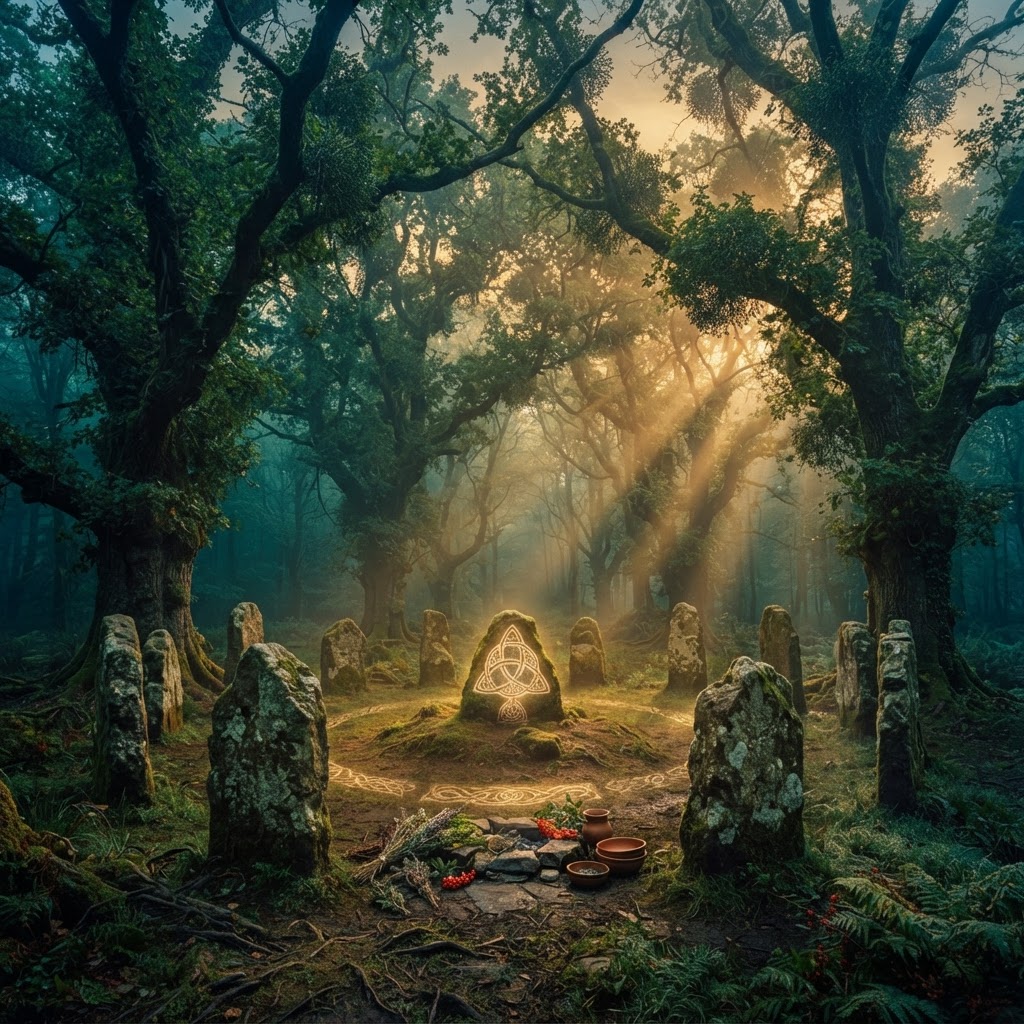
The Druids were the priestly, judicial, and philosophical caste of the ancient Celtic peoples — a class set apart not by birthright alone, but by long initiation. Caesar records that their training lasted as long as twenty years, committed entirely to memory: verse, law, astronomy, natural philosophy, and the hidden names of things. They wrote nothing of consequence down, holding that the written word petrifies a living teaching and that what is carried in the trained mind is kept alive, while what is carved in stone grows cold.
Their very name may descend from the root dru-wid — “oak-knowledge,” or “deep-knowledge of the oak.” The oak was their axis tree, the mistletoe that crowned it their golden sacrament. Pliny describes the white-robed rite: at the sixth moon, a druid climbed the oak, cut the mistletoe in a single stroke, and caught it before it touched earth — a celestial plant lifted down from the heavens, never allowed to return to the soil. In that gesture the whole cosmology is present: light descends from above and is held, suspended, by the human hand.
Three branches stood within the order. The Bards kept the memory — genealogy, praise, satire, the song that could raise a king or unmake one. The Vates (ovates) read the signs — the flight of birds, the turn of the stars, the sacrifices of the oak-grove. The Druids proper held the deepest layer: natural philosophy, the immortality of the soul, the reckoning of time by nights rather than days, and the great doctrine that the cosmos is alive, conscious, and responsive to the trained mind.
They were, in their own understanding, not priests of a god above the world but technicians of the living world itself — mediators between the seen and the unseen, the oak and the star, the human mind and the mind that moves through all things.
One Root · Many Branches
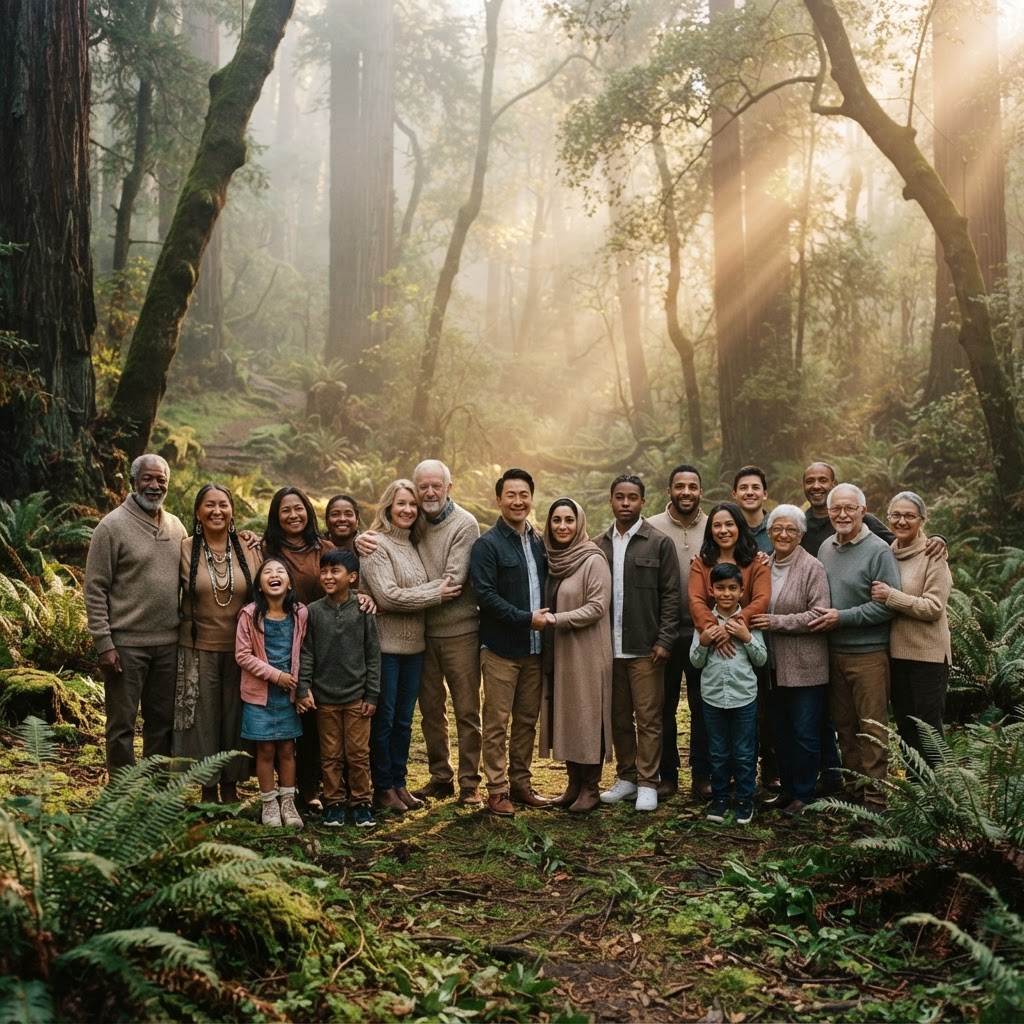
The Tree Shelters Every People
The druid’s tree does not ask the color of the hand that rests against its bark. Beneath the ash, the oak, and the yew, every race of HU-man stands as one root-stock of the same cosmic tree — Caucasian, African, Asian, European, Indigenous, and all the kindreds of the earth, woven into a single green genealogy of the seeking soul. The Celtic mystery was never a tribal possession; it was a forest open to whoever would learn to read it.
II · The Living Alphabet
Sacred Trees & the Ogham
Each letter a tree, each tree a living oracle — the Celtic script was not invented, it was grown.
The Ogham is the earliest Irish alphabet — not a set of abstract signs but a calendar of trees. Each of its twenty letters (the feda, “trees”) is a species: birch, rowan, alder, willow, ash, oak, holly, yew. Carved as strokes along the edge of a standing stone, the script reads upward, root to crown, as a tree grows. To read Ogham was to read the forest.
The tree was the Celtic axis mundi — the vertical that joins underworld root, midworld trunk, and overworld crown. To know a tree was to know a station of the cosmos; to know them all was to hold the whole column of being in the mind. This is why the druid trained in the trees: not as botany, but as a living ladder of consciousness, each ring of growth a rung closer to the light.
Learn the face of each tree, that you may know it when you walk among them.
 Beithe
Birch
Betula pendula
Beginnings, purification, the first stroke of the year.
 Luis
LuisRowan
Sorbus aucuparia
Quickening, protection, the red berry of the lightning tree.
 Fearn
FearnAlder
Alnus glutinosa
The water-tree, oracular fire, the bridge between worlds.
 Saille
Willow
Salix alba
The moon-tree, rhythm, the bending that does not break.
 Nion
NionAsh
Fraxinus excelsior
The world-axis, the ladder of the heavens.
 Duir
DuirOak
Quercus robur
The door, the king of trees, the druid’s own wood.
 Tinne
TinneHolly
Ilex aquifolium
The evergreen spear, endurance through the dark half.
 Ioho
IohoYew
Taxus baccata
Death and rebirth, the longest-lived, the gate between lives.
Tree photographs · Wikimedia Commons (public domain / CC)
II · The Wheel Unveiled
The Celtic Tree-Zodiac
Thirteen lunar trees wound around the twelve signs of the Mazzaroth — the forest calendar and the star calendar read as one wheel.
Celtic Tree
Zodiac
13 Trees · 12 Signs
+ The Nameless Day
Birch
Beithe · Capricorn
Dec 24 – Jan 20
Rowan
Luis · Aquarius
Jan 21 – Feb 17
Ash
Nion · Pisces
Feb 18 – Mar 17
Alder
Fearn · Aries
Mar 18 – Apr 14
Willow
Saille · Taurus
Apr 15 – May 12
Hawthorn
Uath · Gemini
May 13 – Jun 9
Oak
Duir · Cancer
Jun 10 – Jul 7
Holly
Tinne · Leo
Jul 8 – Aug 4
Hazel
Coll · Virgo
Aug 5 – Sep 1
Vine
Muin · Libra
Sep 2 – Sep 29
Ivy
Gort · Scorpio
Sep 30 – Oct 27
Reed
Ngetal · Sagittarius
Oct 28 – Nov 24
Elder
Ruis · Sagittarius
Nov 25 – Dec 22
Read clockwise from the top: each lunar tree-month unveils the solar sign whose arc of sky it walks beneath. The wheel holds thirteen trees to the zodiac’s twelve — the thirteenth, Elder, and the Nameless Day (December 23) are the hinge where the lunar forest-year and the solar star-year meet, close, and begin again at the Birch.
III · The Knot Without End
The Triquetra
Three corners, one continuous line — the geometry of the triplicity that the Celtic mind found at the heart of all things.
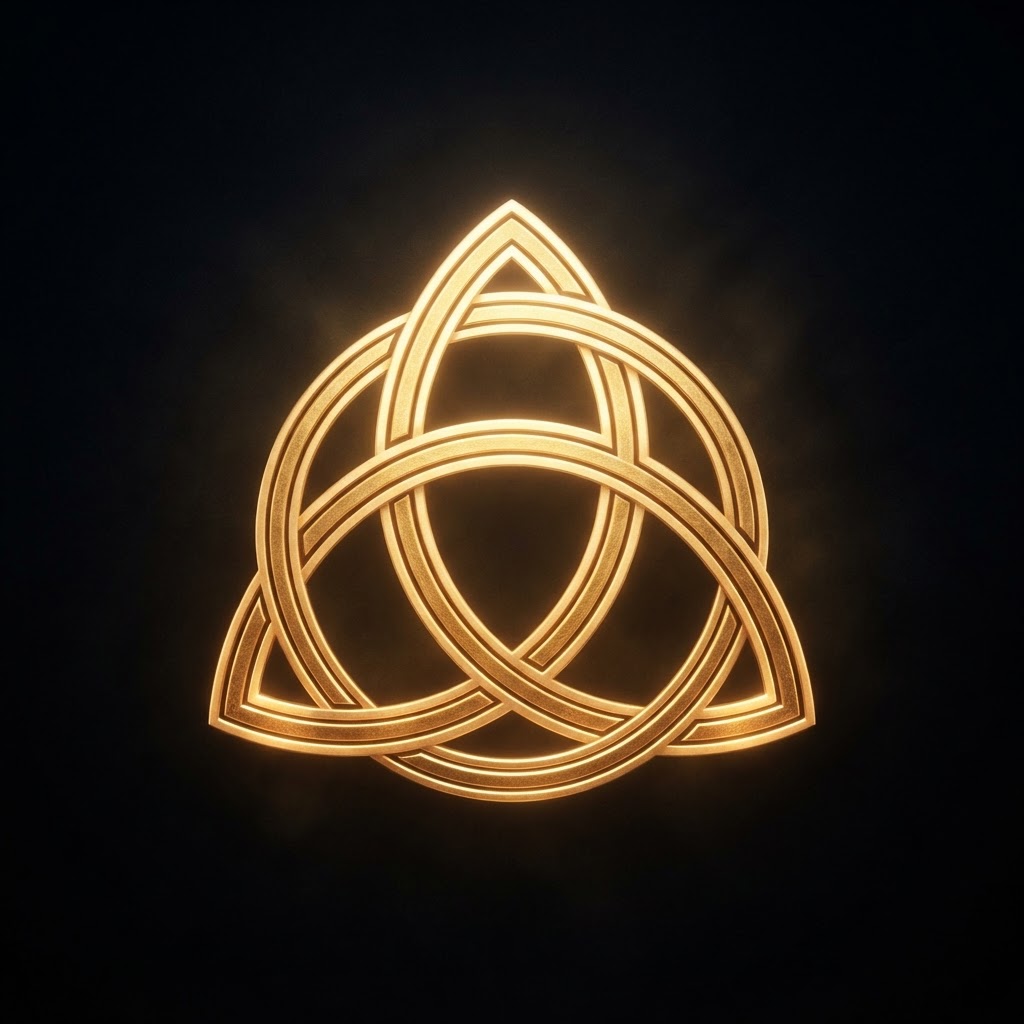
The triquetra — “three-cornered” — is among the oldest of the Celtic knots, and it is built from a single unbroken strand. Three vesica arcs interlace to form three pointed lobes and a central vesica at the heart. Because the line never lifts and never ends, the knot is a diagram of eternity: continuity made visible.
The Celtic imagination was everywhere triadic. The triquetra held the three realms — land, sea, and sky; the three stages — maiden, mother, and crone; the three rays of inspiration — calm, light, and the awen that flows between them. It is not three things joined, but one reality seen in three faces.
When Christianity reached the Celtic west, the triquetra was not discarded but re-read — as Father, Son, and Spirit. The same unbroken line now carried the Trinity. Nothing in the geometry changed; only the name spoken over it. That is the Celtic genius: to hold the older pattern inside the newer word, so that the symbol keeps both meanings at once, and the deep triplicity is never lost.
IV · The Wheel and the Wood
Celtic Cross & Christian Cross
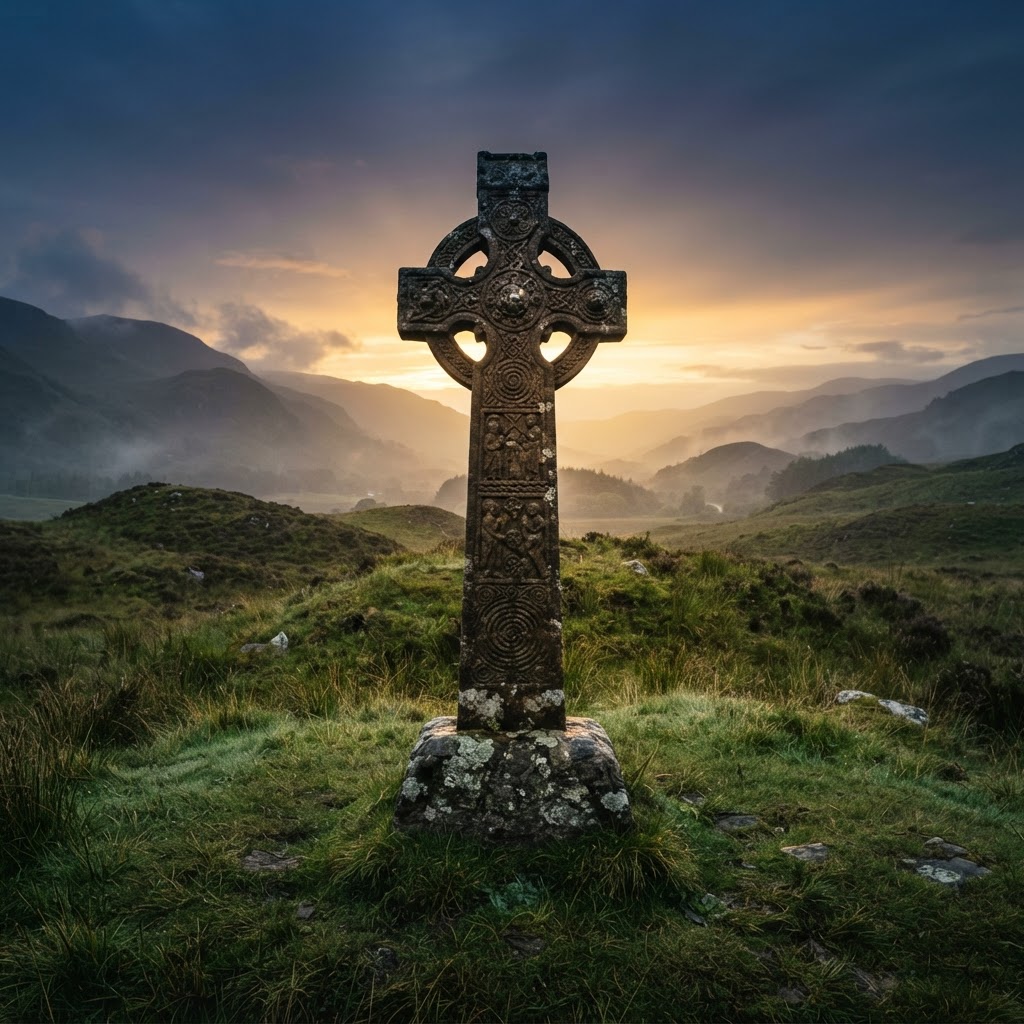
Two crosses, two cosmologies — one linear and historical, one cyclical and solar — and the ring that joins them.
The plain Christian cross is two lines: a vertical dropped from heaven to earth, a horizontal stretched across the human world. Its meaning is an event — the Crucifixion — and a direction: descent and return, the linear arc of salvation history. It points somewhere. It tells a story with a beginning and an end.
The Celtic cross keeps both lines — and then closes a ring around their meeting. The ring is the solar wheel, the cycle of the year, the horizon that the sun never breaks. Where the Christian cross is linear, the Celtic cross is linear and cyclical: the axis of the heavens turning inside the circle of the seasons.
The contrast is the gift. The Christian cross abstracts the cosmos into history; the Celtic cross refuses to let the cosmos go. Its ring says: the light returns, the wheel turns, the sacrifice stands inside an eternity that was already there. The synthesis is exact — when the new faith came, the ring was simply called Christ’s halo, and the sun-wheel and the wood became one sign.
Christian Cross
- ◈Linear & historical
- ◈Event of the Crucifixion
- ◈Descent and return
- ◈Heaven ↔ earth axis
Celtic Cross
- ◈Linear & cyclical
- ◈Sun-wheel ringed round the wood
- ◈Return of the light
- ◈Axis inside the horizon
V · The Deepest Training
Celtic Intel as Cosmic Light
The druid path was not belief — it was a twenty-year discipline of aligning the individual mind with the cosmic mind, until the two were indistinguishable.
At the heart of the Celtic inheritance lies a single Welsh word: awen — the flowing spirit, the breath of inspiration that moves from the source of all things into the trained mind. The druid did not worship a distant god; the druid became a channel. The bard opened to the awen until the poem was no longer composed but received, the vate read the stars until the heavens spoke back, and the druid held the whole until the boundary between knower and known dissolved.
This is cosmic-mind training in its oldest European form. The oak taught rooting; the star taught rotation; the triquetra taught that the many are one continuous line; the cross taught that the axis and the wheel belong together. Each symbol was a station of an inner curriculum whose end was the same end the whole site of Cosmic Ontology pursues: to bring the personal mind into such exact alignment with the cosmic mind that light can pass through it without distortion.
Where modern schooling trains the mind to know about things, the Celtic training trained the mind to be the thing known — to stand as the oak stands, to turn as the star turns, to flow as the awen flows. The triquetra is its diploma: three corners resolved into one unbroken line, the student no longer separate from the source.
“Three things that give stability: the tree, the stone, the star.”
— A Celtic Triad
“Three candles that illumine the darkness: knowledge, nature, and the knot that has no end.”
— A Celtic Triad
“Three branches of learning: the law of the oak, the song of the star, the silence of the stone.”
— A Celtic Triad
VI · The Two Sanctuaries
Celtic & Egyptian Mystery Schools
Two civilizations, one strategy: to carry the hidden Goddess-knowledge through centuries of suppression by encoding it in symbol, tree, and stone.
Across the centuries, two great mystery traditions guarded the same inner teaching by opposite means. In Egypt, the priest encoded the cosmic law in the hieroglyph and the temple — fixed, monumental, built to outlast empires. In the Celtic west, the druid encoded it in the tree, the knot, and the spoken verse — mobile, living, carried in the trained memory and never trusted to stone. One hid the knowledge in what would endure; the other hid it in what would move.
Both did this for the same reason, and against the same threat. As orthodox patriarchal power rose — Roman law in the west, monotheist orthodoxy in the east — the older knowledge of the divine feminine was driven underground. The Goddess was not abandoned; she was veiled. In Egypt, Isis and Hathor retreated behind the temple screen and the initiated name. In the Celtic world, Brigid, the Sheela-na-gig, and the sovereignty-goddess slipped into the knot, the holy well, and the saint’s cloak. The symbol kept what the official word could no longer say aloud.
The purpose was twofold, and both purposes were protective. The first was to protect the knowledge — to keep the inner cosmology, the divine feminine, the living cosmos intact for those who could still read it, century after century, while the surface of the world changed hands. The second was to protect the seeker — because the mystery schools held that a sacred truth handed unprepared to an uninitiated mind does not free it; it breaks it. The veil was not exclusion but mercy: a gate that opened only at the speed of the student’s capacity.
This is why the Celtic page sits beside the Egyptian artifact room in this Academy, and why both sit beneath the same gold light. They are two hands of one tradition — one writing the secret on the wall, one carrying it in the wind — and the seeker who learns to read both reads the same single sentence: the cosmos is alive, the feminine is its heart, and the mind that aligns with them is never alone.
VII · The Druidic Return
Gooberz
Linda Goodman’s 1,081-page metaphysical poem — a love story wound around the druidic doctrine of the eternal, returning soul.
Gooberz
by Linda Goodman
Hampton Roads · 1989
Gooberz is astrologer Linda Goodman’s towering 1,081-page semi-autobiographical poem, published in 1989 and split into twenty-one cantos. At its surface it is a love story; beneath, it is an esoteric manifesto — and its load-bearing beam is the oldest druidic doctrine of all.
Caesar recorded that the druids taught the immortality of the soul and its passage, after death, into another body — a doctrine meant to make the warrior fearless and the seeker wakeful. Goodman takes that druidic premise and builds the whole architecture of her book upon it: the soul is eternal, love recurs across lifetimes, and the cosmic mind weaves every incarnation toward a reparation the surface world has forgotten how to make. The two lovers of Gooberz are not meeting for the first time; they are remembering.
This is the druidic premise made narrative: that memory is older than one life, that the awen — the flowing inspiration — pours across incarnations, and that the trained mind can recover what the forgetful age has buried. Goodman worried openly over the annihilation of the earth and the broken state of human relationships, and she hoped this book would mend them — a hope straight out of the druid’s office: keeper of memory, mediator between the living and the dead, technician of the return.
Read beside the triquetra and the sun-cross, Gooberz becomes what Goodman intended: a modern canto of the Celtic mystery — the knot without end, the light that returns, and the soul that the druids promised would never, truly, be lost.
Sources & References
Seeker's Comments
Your words travel privately to Dr. Nannette E. O'Neal, Ph.D. — they are not published or shared with other seekers.