Chamber I · 龍
The Dragon in Every Sky
The cross-cultural codex — and the three motifs every culture drew
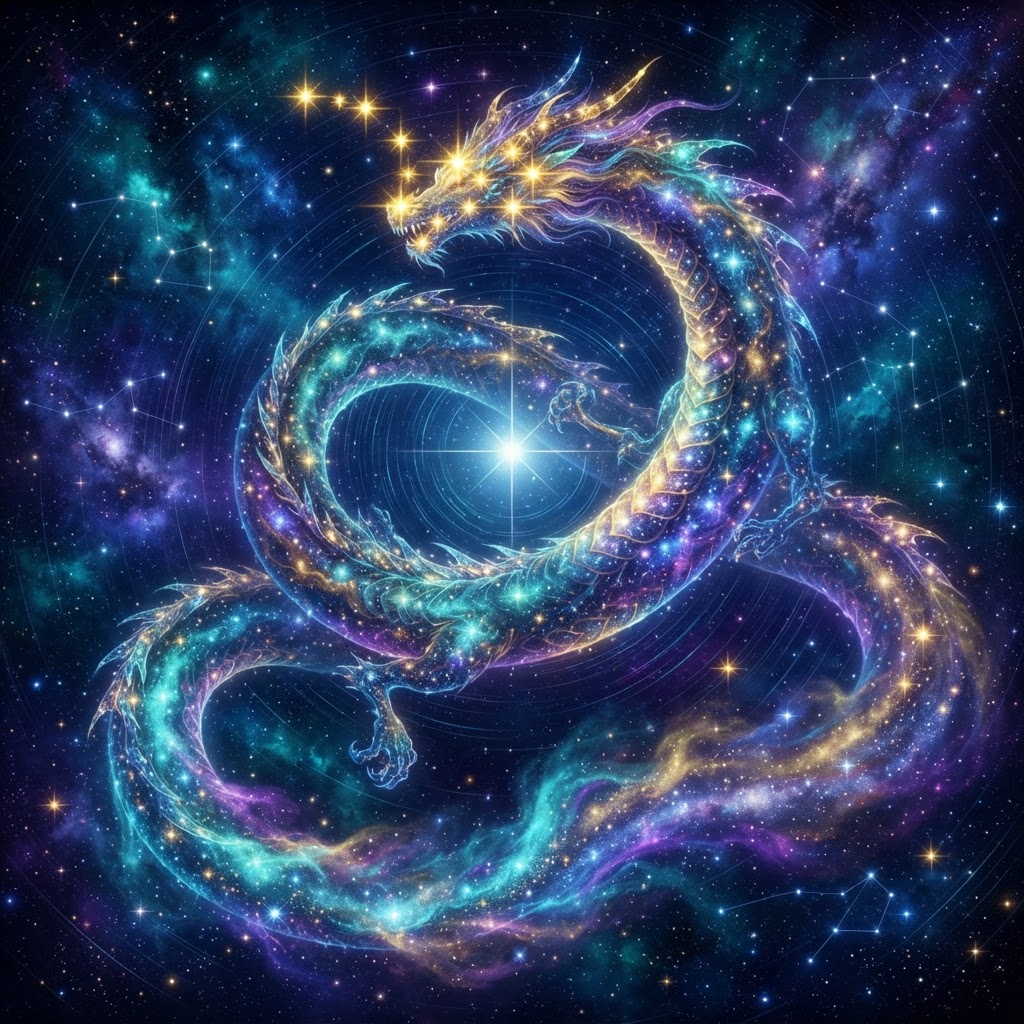
Begin where the evidence is loudest. No traders carried the dragon between China and Peru, between Wales and the Nile, and yet the same animal appears in all of them: a serpent, coiled, and winged or antlered, guarding something it will not release.
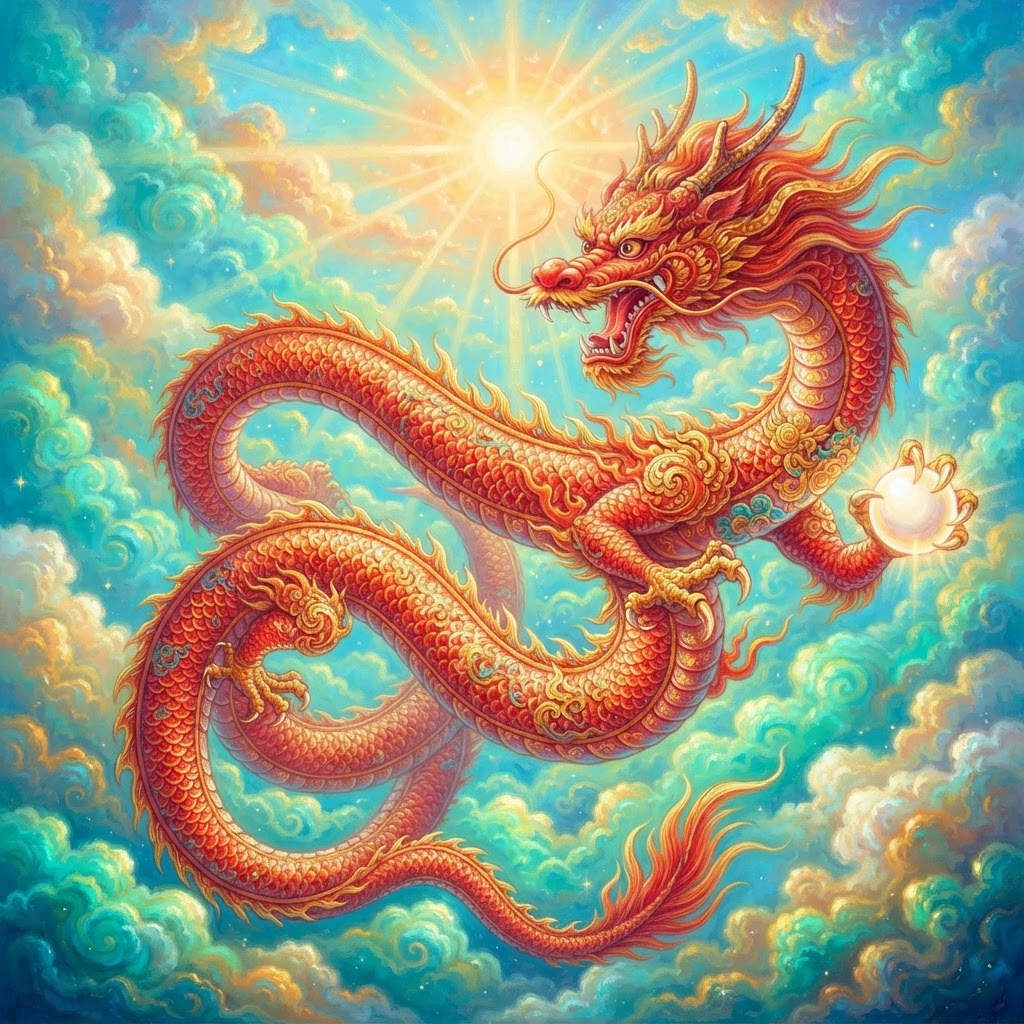
China named it lóng 龍 — not a monster but an officer of the sky: the minister of rain, the spine of the river, the emblem of the emperor himself. Five claws were reserved for the throne; a four-clawed dragon belonged to a prince; anyone else who wore it was executed. Its body was said to be built from nine resemblances — the head of a camel, horns of a deer, eyes of a rabbit, ears of an ox, neck of a snake, belly of a frog, scales of a carp, claws of an eagle, paws of a tiger. Read that list again: it is not a zoology. It is a portrait of a nervous system that can hear, see, swallow, climb, grip and fly in the same breath.
What does the Chinese dragon chase? The Pearl — a luminous sphere it never quite catches. Not gold, not power. The pearl is concentrated mind-light, the bright drop at the crown. The most ancient dragon in the world is a creature in pursuit of its own awakened centre.
India kept both faces of the serpent and refused to choose between them. The nāgas are the wise ones, hooded cobras who guard water, treasure and secret knowledge; a nāga hood sheltered the Buddha in the rain. Ananta Śeṣa is the endless serpent on whom Vishnu dreams the universe. But Vṛtra is the dragon of obstruction, whom Indra must split to release the blocked waters. India understood first: the same serpent is either the guard of the treasure or the thing that dams the river, depending entirely on whether it has risen.
In Mesopotamia the dragon is the mother of the world and then its floor-plan. Tiamat, the salt sea, is split in two — one half becomes the sky, the other the earth. Her dragon form, the mušḫuššu, was glazed in bright blue brick across the Ishtar Gate of Babylon and walked in procession for centuries: a dragon with the head of a snake, the forelegs of a lion, the hind legs of a bird, and a scorpion’s tail. Ground, air and sting in one body.
Egypt kept the serpent at the exact centre of state and terror. Apep, the great serpent, swallows the sun barque every night and must be cut open every dawn by the knife of Set. And on the brow of every pharaoh sat the uraeus — the same cobra, reared, ready to strike — the crown of the awakened spine. The serpent that is feared below is the serpent that is worshipped above. Egypt drew the entire doctrine and never wrote a word of it.
The Norse ringed the world with it. Jörmungandr lies in the ocean with its tail in its mouth — the horizon as a coil — and Níðhöggr gnaws the root of the world-tree from below: the dragon at the base, feeding on what everything else is built upon. Greece set Ladon to guard the golden apples in the tree — the hoard again, in a tree, guarded by the serpent — and kept Python at Delphi, where the older oracle spoke through the serpent until the new solar order took the shrine.
Mesoamerica solved the symbol openly: Quetzalcoatl is literally the feathered serpent — quetzal, the bird of the sky, married to coatl, the serpent of the earth. The marriage is not hidden in a metaphor; it is in the name. At Chichén Itzá, at the equinox, the staircase of Kukulcán casts a serpent of shadow that descends the pyramid step by step. Sky and earth, light and stone, meeting on a stair of seven — the spinal ladder drawn at the scale of a city.
And Wales still flies it on a flag: Y Ddraig Goch, the red dragon, older than the crown. Pendragon means head-dragon — the title of a war-leader who carried the serpent-power at the front of the column. Medieval Europe then turned the guardian into the last obstacle: the hoard-keeper of Beowulf, the beast of the Apocalypse, the thing a saint must kill to be a saint.
Now the unveiled pattern. Every one of these cultures drew the same three motifs and gave them different names: a COIL around an axis, a tree, an egg or a hoard; a WING, or antlers, or a feathered crest — the power to leave the ground; and a HOARD that must not be taken (gold, pearl, apples, wisdom, the waters, the bride). Coil, wing, hoard. Serpent, hemisphere, treasure. No culture ever drew a dragon casually.
China
龍 lóng — rain, the emperor, and the Pearl of Wisdom it chases but never catches
Mesoamerica
Quetzalcoatl — “feathered serpent”: the bird and the snake married in the very name
Babylon
mušḫuššu — glazed blue on the Ishtar Gate: snake head, lion legs, eagle talons, scorpion tail
Egypt
Apep below, uraeus above — the same cobra, either the enemy or the crown
India
Ananta Śeṣa the endless dreamer-serpent beside Vṛtra the dam that Indra must split
Wales
Y Ddraig Goch · Pendragon — “head-dragon”, the serpent carried at the front of the march