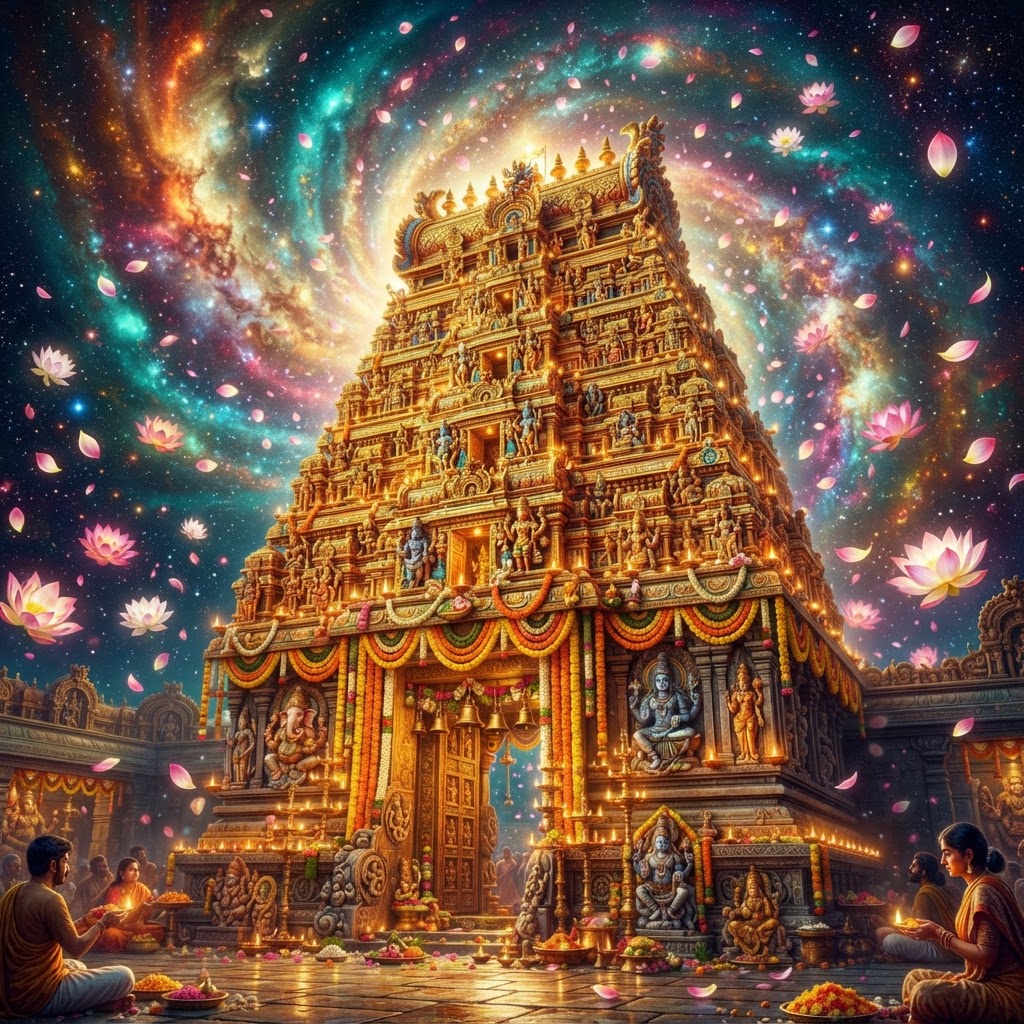
 ॐ
NAV · The Eternal Way
Sanatana Dharma
Hinduism · The Buddha · Shakti & Shiva
The oldest living stream of wisdom on Earth. It has no founder and no single book — it is a river with thousands of mouths, carrying the Vedas, the Upanishads, the Bhagavad Gita, the Buddha's Middle Way, and the marriage of Shakti and Shiva. This page is a deep reading of that river: what it actually teaches, how its sciences work, and where its two great currents — consciousness and power — meet.
4
Vedas
108
Principal Upanishads
18
Gita Chapters
5,000+
Years of Continuity
The Eternal Way
Not a Religion. A Civilisation of the Inner Fire.
Sanātana Dharma means "the eternal way" — the name its own people gave it long before anyone called it Hinduism. It has no single founder, no single prophet, no single book, and no excommunication. What holds it together is a method: investigate consciousness directly, in every possible way, and record what works. Everything else on this page — the gods, the sciences, the Buddha, the marriage of Shiva and Shakti — is a return of that one experiment.
The Unfolding
c. 3300–1900 BCE
Indus–Sarasvatī Civilization
Seals showing a yogic seated figure, swastika, pipal tree and horned deity — the earliest visual grammar of what will later be called Sanatana Dharma.
c. 1500–900 BCE
The Vedic Age
The Ṛg, Sāma, Yajur and Atharva Vedas are composed and sung: the world's oldest continuously transmitted liturgy, memorized with mathematical precision for 3,000 years.
c. 800–200 BCE
The Upanishads — the turn inward
The ritual gives way to the question of the Self. "Tat tvam asi" — That thou art. The inner fire becomes the central subject of the tradition.
c. 500 BCE
The Buddha
Siddhartha Gautama diagnoses suffering and prescribes the Eightfold Path — a reform movement born inside the same Upanishadic world.
c. 400 BCE–400 CE
The Epics
The Mahābhārata and Rāmāyaṇa teach dharma through story; the Bhagavad Gītā becomes the most-read scripture of the tradition.
c. 300–1200 CE
Puranas, Tantras & Temple Science
The eighteen Purāṇas, the Āgamas and Tantras, the great stone temples — India builds its cosmology in granite and reveals the Śakti as the operative power of the cosmos.
c. 700–1700 CE
The Bhakti Wave
Devotional poets in every language — Tamil, Hindi, Bengali, Marathi — make liberation available to the householder, the woman, the outcaste.
1800 CE → now
The Modern Transmission
Rāmakrishna, Vivekananda, Aurobindo, Ramana Maharshi and today's teachers carry the Vedanta into the planetary conversation — where this page now sits.
The Twelve Words That Hold It All
Brahman
The boundless ground of all being — not a god among gods, but the very stuff of existence, consciousness, and bliss (sat-chit-ānanda).
Ātman
The Self within. Not the personality, but the witnessing awareness that no birth, body or memory owns.
Māyā
The measuring power that makes the One appear as many. Not "illusion" as lie — illusion as a genuine but partial display.
Karma
Action and its resonance. Every act leaves a groove in awareness that must eventually be walked.
Dharma
That which upholds. Your right function in this life — the duty that fits your nature and your moment.
Samsāra
The wheel of birth and death: consciousness circling until it recognizes what it always was.
Moksha
Liberation — the wheel stilled because the witness is known. Called nirvāṇa when the Buddha describes the same fire going out.
Puruṣārtha
The four aims of a human life: dharma (right living), artha (prosperity), kāma (desire), mokṣa (liberation).
Āśrama
The four stages: student, householder, forest-dweller, renunciate — a life with a spine, not a shopping list.
Guṇas
The three strands of nature: sattva (lucidity), rajas (motion), tamas (inertia) — braided in everything, including your mood today.
Yuga
The great measure of time: Kṛta, Tretā, Dvāpara, Kali — 4,320,000 years in a full cycle, closing and reopening the curriculum.
Prana
The life-breath and its five winds. The bridge between body and awareness — the reason breath is the first tool of yoga.
The Trimūrti — Three Faces of One Function
Brahmā
The Creator
The designer of worlds, seated on the lotus that grows from Viṣṇu's navel. Rarely worshipped today — creation is understood to be ongoing, not a past event.
Viṣṇu
The Sustainer
The steady centre of this world-age, with ten great descents (avatāras) — from the fish and the boar to Rāma, Kṛṣṇa, and the Buddha in most lists.
Shiva
The Transformer
Not "the destroyer" in our sense: he dissolves form so that form may be reborn. The tradition gives him his own full treatment below.
Four Roads Up the Mountain
Jñāna Yoga
The path of knowingRelentlessly asking "Who am I?" until every wrong answer burns away and only the seer remains.
Bhakti Yoga
The path of loveThe heart as the instrument: devotion so total that the lover and the Beloved reveal themselves as one.
Karma Yoga
The path of actionAct fully, release the fruit. Kṛṣṇa's answer to Arjuna — work without the wound of ownership.
Rāja Yoga
The path of the mindPatañjali's eight-limbed discipline: still the modifications of the mind and the Self stands revealed.
The Six Darśanas — A Complete Philosophy
Sāṃkhya
The map of consciousness and nature — puruṣa and prakṛti, twenty-five tattvas.
Yoga
The applied branch of Sāṃkhya: Patañjali's 196 aphorisms on practice.
Nyāya
Logic, inference and the rules of valid knowledge — India's epistemology.
Vaiśeṣika
Atomism and categories: the physical world taken seriously and analysed.
Mīmāṃsā
Language, ritual and sound: how a mantra operates on reality.
Vedānta
The end of the Vedas — the Upanishads as the final court of appeal.
Logic, atomism, cosmology, ritual science, psychology and metaphysics — six independent schools arguing for two thousand years inside one civilisation. That argument is the tradition. It never needed everyone to agree.
The Divine Assembly
One Reality, Ten Thousand Faces
The tradition is often mistaken for polytheism. It is closer to a single light passed through ten thousand instruments — each deity a precise description of one faculty, one force, one way consciousness behaves. Tap any face below to read what it actually governs.
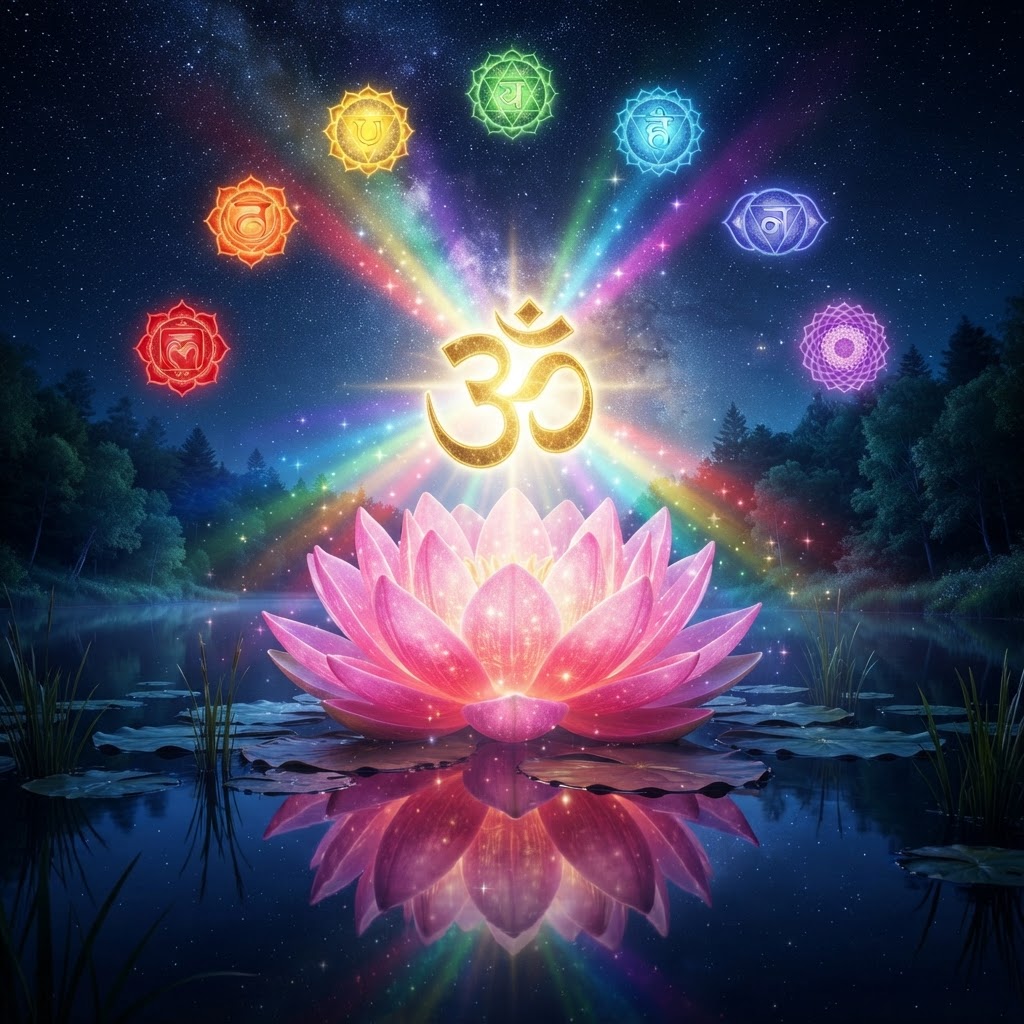
The Library
A Scripture for Every Kind of Mind
Hymns for the poet, aphorisms for the logician, epics for the householder, tantras for the practitioner. Nothing was thrown away; every temperament was given a door. These are the eight doors that built a civilisation.
Oṃ — the sound the universe makes when it remembers itself.
The Four Vedas
c. 1500–900 BCE · Ṛg · Sāma · Yajur · Atharva — 10,000+ hymns
The world's oldest living liturgy: hymns (Ṛg), melodies (Sāma), ritual formulas (Yajur), and the knowledge of everyday life, healing and protection (Atharva). Transmitted orally with such exactness that modern recitations match recordings made a century ago, syllable for syllable. The Vedas are not read; they are *toned*. Their claim is that sound itself is a creative power — the basis of the Academy's Light Code work.
The Upanishads
c. 800–200 BCE · 108 principal texts
The philosophical summit of the Vedas. The great statements — *Tat tvam asi* (That thou art), *Aham Brahmāsmi* (I am Brahman), *Ayam Ātmā Brahma* (This Self is Brahman), *Prajñānam Brahma* (Consciousness is Brahman) — are not beliefs to accept but recognitions to arrive at. Their method is subtraction: not-this, not-this, until only awareness remains.
The Bhagavad Gītā
c. 200 BCE · 18 chapters · 700 verses
A battlefield dialogue between a warrior who cannot move and the divine charioteer who will not let him quit. In eighteen chapters it delivers the whole tradition — action, devotion, knowledge, the field and its knower, the three guṇas, the vision of the cosmic form, and the final teaching: abandon all formulas and take refuge in Me. Gandhi called it his dictionary of conduct; the Academy calls it the clearest manual for a mind that still has work to do.
Mahābhārata & Rāmāyaṇa
c. 400 BCE–400 CE · 100,000 verses · 24,000 verses
The two great epics that carried the tradition to every village in Asia. The Mahābhārata contains the Gītā inside it; the Rāmāyaṇa gives the template of rectitude under pressure. Their real subject is dharma — how it bends, where it breaks, and why a rule is sometimes the wrong answer.
The Purāṇas
c. 300–1000 CE · 18 Mahāpurāṇas
Encyclopedias of the sacred: cosmology, genealogy, geography, ritual, astronomy and the lives of the avatāras, written to be told aloud by grandmothers and priests alike. They are the reason a farmer and a philosopher can use the same vocabulary for the infinite.
The Yoga Sūtras of Patañjali
c. 400 CE · 196 aphorisms · 4 chapters
The operating manual of the mind. Yoga defined in the second aphorism as the stilling of the modifications of consciousness; then the eight limbs, the obstacles, the powers that arise from practice, and the final isolation of the seer in its own nature. Every modern yoga studio descends from this text, even when it forgets the point.
The Six Schools of Vedānta
c. 700–1200 CE · Advaita · Viśiṣṭādvaita · Dvaita and more
Śaṅkara argues for radical non-duality — the world is Brahman appearing as many. Rāmānuja answers that the many are real as the body of the One. Madhva insists on an eternal distinction between God and soul. The tradition lets them argue for a thousand years because a living philosophy must be able to disagree with itself.
The Tantras & Āgamas
c. 600–1300 CE · Hundreds of revealed texts
Where the Vedas purify through ritual, the Tantras transform through direct engagement: mantra as sound-body, yantra as diagram-body, deity as the shape of your own awakened power. They produced the chakra system, the kundalini teaching, and the Śrī Yantra — and they lead directly into the Śakti half of this page.
The Sciences
India Built Instruments, Not Just Altars
The same civilisation that sang the Vedas calculated π, described the rotation of the Earth, performed cataract surgery, formalized zero, and mapped the sound of every letter to a seat in the body. Spirit and science were never opponents here — measurement was considered a form of worship.
Mathematics
- ◆Zero as a number with a place value — formalized by Brahmagupta (628 CE) and carried to Baghdad, and from Baghdad to the rest of the world.
- ◆Baudhāyana's Śulbasūtras (c. 800 BCE) state the Pythagorean theorem centuries before Pythagoras, and give √2 accurate to five decimal places.
- ◆Āryabhata (499 CE) computes π to 3.1416, explains eclipses, and states that the Earth rotates on its axis — a thousand years before Copernicus is born.
- ◆Pingala's Chandas Śāstra describes binary enumeration and the Fibonacci sequence in metre long before Fibonacci.
- ◆Mādhava of Saṅgamagrāma (c. 1400 CE) writes infinite series for sine and cosine — three centuries before Newton and Leibniz.
Ayurveda
- ◆The five elements (ākāśa, vāyu, agni, ap, pṛthvī) condense into three doṣas: vāta (air-motion), pitta (fire-transformation), kapha (water-structure).
- ◆Health is not the absence of symptoms but the balance of the doṣas with agni (digestive fire), ojas (vital essence) and prāṇa (life-breath) in good order.
- ◆The science of daily rhythm — dinacaryā — times sleep, food, work and practice to the sun rather than to the clock.
- ◆Breath as medicine: prāṇāyāma measured in the three-phase count (inhale, hold, exhale) to shift the nervous system at will.
- ◆Its foundation texts — Caraka Saṃhitā, Suśruta Saṃhitā (which describes cataract surgery and over 300 procedures) and Vāgbhaṭa's Aṣṭāṅga Hṛdaya — are still in clinical use.
Jyotiṣa — the Vedic Sky
- ◆27 nakshatras (lunar mansions) measure the sky in a finer grain than the 12 zodiacal signs; the Moon's passage through them is the spine of a Vedic chart.
- ◆Nine grahas including the lunar nodes Rāhu and Ketu — the eclipse-points that carry karmic memory in the tradition's reading.
- ◆Time is chosen, not merely endured: muhūrta selects the moment for a marriage, a foundation, or a first lesson.
- ◆The yugas set the astrological weather: we are said to be in Kali Yuga, which is why the tradition insists on practice over talent.
- ◆Cross-reference with the Academy's Zodiac and Cosmic Puzzle pages: the same 12 signs, read from a different continent and a different intention.
Sanskrit & Mantra Science
- ◆Pāṇini's Aṣṭādhyāyī (c. 500 BCE) — 3,959 rules that generate an entire language with the economy of a computer program. Noam Chomsky cited it as evidence that grammar is an innate human structure.
- ◆The varṇa-mālā: 50 letters arranged as the body of the goddess, with each sound assigned a seat in the mouth and a frequency of its own.
- ◆Bīja mantras (Oṃ, Hrīṃ, Śrīṃ, Klīṃ, Aiṃ) — seed-sounds used as instruments rather than sentences; the practitioner is understood to be tuning, not informing.
- ◆The four levels of speech in the Tantras: vaikharī (audible), madhyamā (mental), paśyantī (visionary), parā (transcendent) — a map of how a sound becomes a world.
- ◆The Academy reads this as the original Light Code: a script engineered so that uttering it moves the nervous system, not merely the mood.
Temple Science
- ◆The temple is a body: garbhagṛha as the womb, entrance as the birth canal, the spire as the crown, the deity as the seated Self.
- ◆The Śrī Yantra — nine interlocking triangles forming 43, with a bindu at the centre — is the geometric signature of the goddess, drawn as a meditation device.
- ◆Vāstu Śāstra aligns a building to the cardinal directions and the path of the sun, so the structure works with light rather than against it.
- ◆Mandalas are cosmograms, not decoration: a diagram you walk, in which the pilgrim traverses their own subtle body.
- ◆Compare the Academy's Sacred Geometry and Architecture of Consciousness pages — the same proportions, the same body-as-building correspondence, in stone.
And It Was All Walked — The Pilgrimage Circuits
12 Jyotirliṅgas
The twelve sanctuaries of Shiva as a pillar of light, from the western sea to the high Himalaya.
51 Śakti Pīṭhas
The subcontinent mapped as the body of the Goddess, each site a limb of the divine feminine.
Char Dham
The four cardinal abodes — north, west, east and south — walked as a national mandala.
Vārāṇasī / Kāśī
The oldest continuously inhabited city on Earth, built on the Ganges and aligned to the rising sun.
The Living Tradition
Five Thousand Years, Still Burning
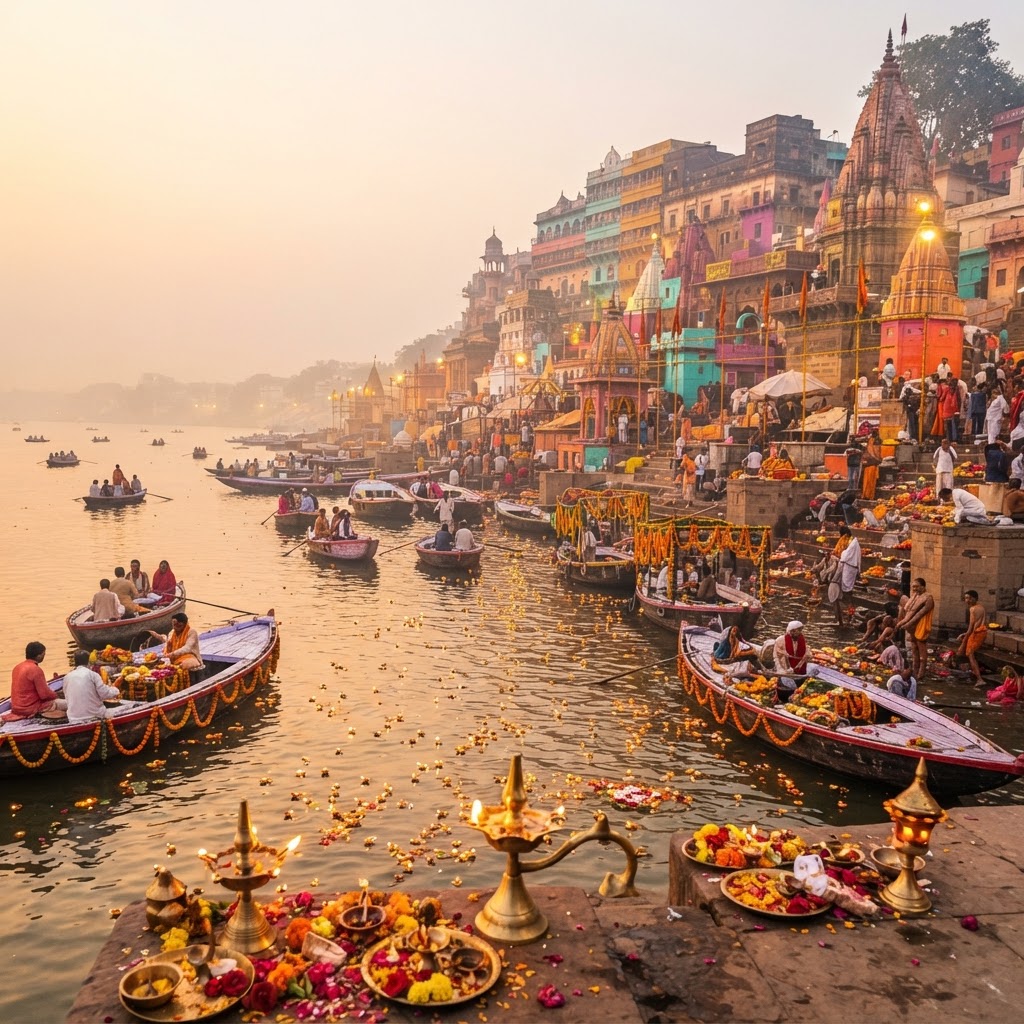
This is not a dead civilisation studied in museums. Every night on the Ganges, brass lamps are lifted in the same motion described in the Vedas. Every autumn, nine nights are given to the Goddess. The tradition is not remembered — it is still being performed, by hundreds of millions of people, tonight.
Film I — Vārāṇasī at dusk: oil lamps and marigold petals carried downstream on the Ganges, the same offering the Ṛg Veda describes. Silent by design; let it play under the words below.
The Sacred Calendar
Dīpāvalī
Oct–NovThe festival of lamps — light rows lit at the darkest point of the year. Lakṣmī is welcomed; old debts are settled; the inner lamp is the real subject.
Mahāśivarātri
Feb–MarThe great night of Shiva — a fast, an all-night vigil, and four watches of worship as the moon wanes to its darkest.
Navarātri
Sept–OctNine nights of the goddess in three movements: Durgā for courage, Lakṣmī for plenty, Sarasvatī for wisdom.
Holī
MarThe festival of colours — the burning of Holikā and the throwing of powdered pigment. Boundaries are dissolved for a day so they can be re-drawn honestly.
Gaṇeśa Caturthī
Aug–SeptClay images of Gaṇeśa are invited into homes, honoured for days, then carried to the water and dissolved — a complete teaching in attachment.
Kumbh Melā
Every 3 / 6 / 12 yearsThe largest gathering of human beings on Earth, at the confluence of rivers. Tens of millions bathe together for the release of karma.
Walked, Not Just Believed
The 12 Jyotirliṅgas
The twelve sanctuaries where Shiva is said to have appeared as a pillar of light — from Somnāth in the west to Kedārnāth in the Himalayas.
The 51 Śakti Pīṭhas
The places where the goddess's body is said to have fallen to earth: the subcontinent mapped as the body of the Śakti.
Char Dham
The four cardinal abodes — Badrinath, Dwarka, Puri, Rameswaram — a national mandala walked on foot.
Vārāṇasī / Kāśī
The oldest continuously inhabited city on Earth, built on the Ganges. To die here, the tradition says, is to have the wheel loosened at the last breath.
The Buddha · The Awakened One
One Man, One Question, One Night Under a Tree
He was not a god who descended. He was a prince who could not stop asking why people suffer — and who sat down under a pīpal tree and refused to get up until the question was answered. What he found became the second great current of this page.
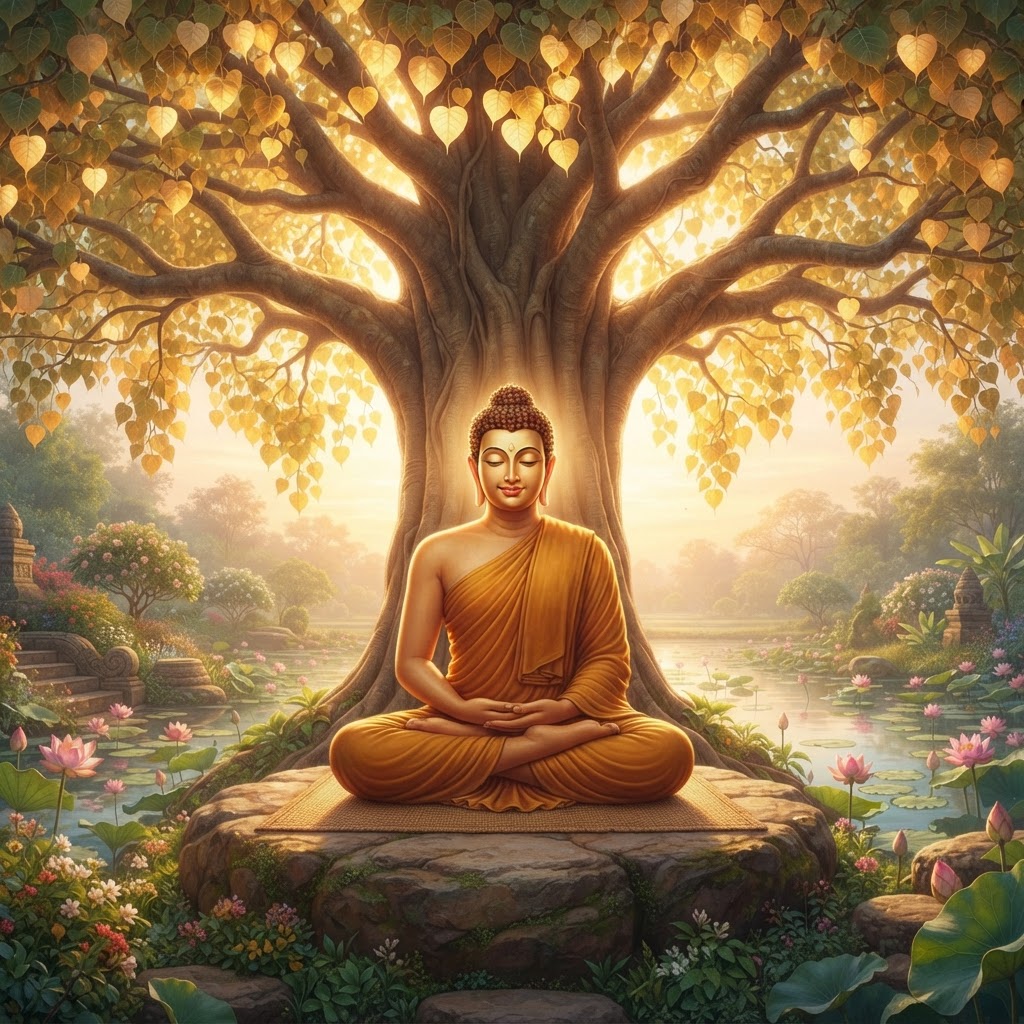
Film II — morning light through the leaves of the Bodhi tree onto a lotus pond. The tradition holds that the awakening happened at the moment the morning star appeared: not a vision granted, but an attention that finally stopped moving.
The Life · Ten Stations
Birth · c. 563 BCE
Lumbinī
Siddhārtha Gautama is born into the Śākya clan. The seer Asita reads the marks on the infant and weeps — the child will wake up, but not stay to rule.
Age 16–29
The palace at Kapilavastu
Sheltered in pleasure, married to Yaśodharā, father of Rāhula. The kingdom arranges a life designed to hide the four sights from him.
Age 29
The Four Sights
An old man, a sick man, a corpse, and a serene mendicant. The last one shows that aging, illness and death can be walked through with an untroubled face — and the question becomes unbearable.
Age 29
The Great Renunciation
He leaves in the night, cuts his hair, and exchanges silk for rags. Not out of despair, but because the question of suffering has become the only thing in the world.
Six years
The Forest Ascetics
Two teachers, then a company of five ascetics. He reduces his body to a skeleton and discovers the dead end: the mind cannot be stilled by wrecking its instrument.
Age 35
Sujātā's bowl of rice-milk
A village woman feeds him. He accepts — the body recovers, strength returns, and the Middle Way is discovered by eating a meal.
Age 35
Bodh Gayā — under the pīpal tree
He sits with the vow not to rise until the question is answered. Mara attacks with desire, fear and doubt. He touches the earth as witness (bhūmisparśa mudrā) and the morning star rises.
Age 35
The First Sermon · Deer Park, Sārnāth
To the same five ascetics: the Four Noble Truths and the Eightfold Path. The wheel of the dharma is set turning and has not stopped.
45 years
The Teaching
Nothing is withheld, including the fact that the path is a raft for crossing, not a doctrine to be defended. He teaches kings, courtesans, farmers and children in the same tone.
Age 80
Parinirvāṇa · Kuśinagarī
Between two sal trees he tells his attendant Ānanda: be a lamp unto yourselves; the dharma is the teacher now. Not a person to worship — but a method to walk.
"Be a lamp unto yourselves. The teaching is your teacher now."
The last instruction, Mahāparinibbāna Sutta
The Dharma · The Diagnosis and the Cure
Four Truths, Eight Steps, No Metaphysics Required
The Buddha refused to answer questions about the origin of the universe, whether the soul survives death, or what lies beyond — not because he had no view, but because the answers do not stop the burning. His teaching is deliberately practical: name the illness, name its cause, confirm it can end, prescribe the treatment. Everything below is that prescription.
The First Truth — Dukkha
Life carries an unsatisfactoriness even when it is beautiful: the ache of things changing, the tightness of holding what cannot be held. Not pessimism — diagnosis. The physician names the condition before prescribing.
The Second Truth — Samudaya
The cause is craving: grasping, aversion, and the fog of not seeing clearly. Craving is not desire itself but the tightening around it that says *this must last, this must be mine*.
The Third Truth — Nirodha
That grip can be released, here and now. Not by forcing anything away, but by seeing accurately — and the tradition is emphatic that the release is real, testable and available in this life.
The Fourth Truth — Magga
The Eightfold Path: the practical cure. Eight simultaneous aspects of one movement — three concerning conduct, three the training of mind, three wisdom.
The Noble Eightfold Path
Right View
Seeing how karma, change and the absence of a fixed self actually operate.
Right Intention
Renunciation, goodwill and harmlessness as the motive behind every act.
Right Speech
Truthful, useful, timely, kind. Speech is where the mind is caught out first.
Right Action
Non-harming, honesty, and sexual integrity in a world where actions echo.
Right Livelihood
Earning without damage — the only economic rule any wisdom tradition has ever needed.
Right Effort
Prevent, release, cultivate, sustain. Practice as a gardener, not a soldier.
Right Mindfulness
Attention held to body, feeling, mind-state and truth — the four foundations.
Right Concentration
The jhānas: absorption refined until the mind is a still, radiant instrument.
The Three Marks
Anicca (all conditioned things change), dukkha (none of them finally satisfy), anattā (none of them are a fixed self you can possess).
Dependent Origination
Twelve linked conditions from ignorance to birth and death. Nothing exists on its own footing — everything is supported by everything else.
The Five Precepts
Do not kill, steal, lie, misuse sexuality, or cloud awareness. Not commandments handed down; trainings taken up and retaken.
The Four Immeasurables
Mettā (loving-kindness), karuṇā (compassion), muditā (joy in others' fortune), upekkhā (equanimity). The heart, trained like a muscle.
The Three Refuges
Buddha (the possibility of waking), Dharma (the method), Sangha (the company that keeps you honest).
Karma & Rebirth without a self
Not the same person travelling — a current continuing. The flame lights the next candle; nothing is transferred and nothing is lost.
Emptiness · Śūnyatā
Nāgārjuna's logic: form is not other than emptiness. Absence of inherent existence is exactly what makes appearance possible.
The Two Truths
Conventional and ultimate — the world is fully real while you are in it, and fully transparent when you look straight through it.
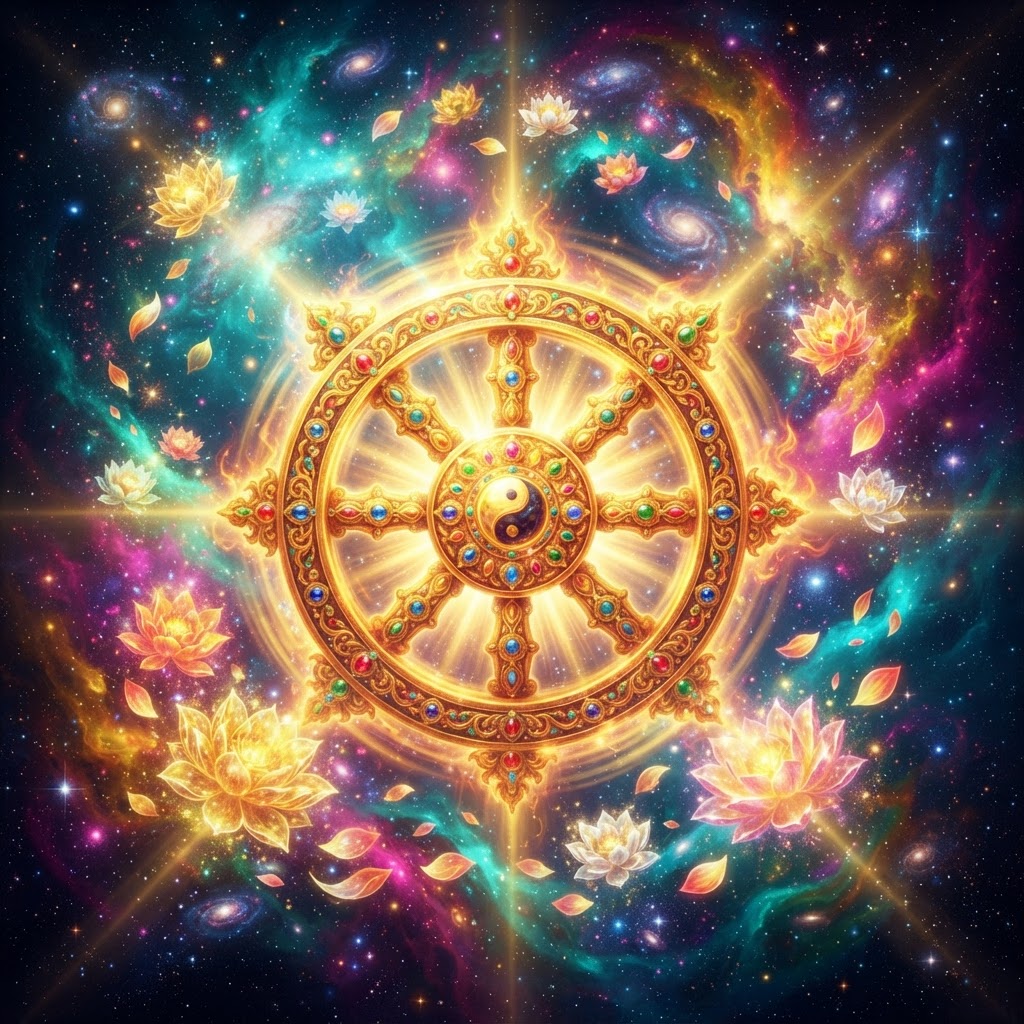
One Teaching, Many Vehicles
Theravāda
Sri Lanka · Thailand · Myanmar · Cambodia · Laos
The Way of the Elders: the Pāli canon, insight practice, awakening of the individual practitioner, and the arhat as the goal.
Mahāyāna
China · Japan · Korea · Vietnam
The Great Vehicle: the bodhisattva vow to postpone final peace until every being arrives, with emptiness as the central philosophy.
Vajrayāna
Tibet · Mongolia · Bhutan
The Diamond Vehicle: tantra inside Buddhism — deity yoga, mantra, visualisation, mudra. Transformation of the afflictions rather than their removal.
Zen / Chan
Japan · China
The direct pointing: sitting, koan, breath. The shortest possible route between a question and its dissolution.
Pure Land
Japan · China · Vietnam
The devotional path of Amitābha's vow — the heart reaches what the intellect cannot climb to.
The Buddhist Light
universal
Be a lamp unto yourself. In the final teaching the Buddha refuses to appoint a successor and points at the practitioner's own clarity — the same address the Academy gives.
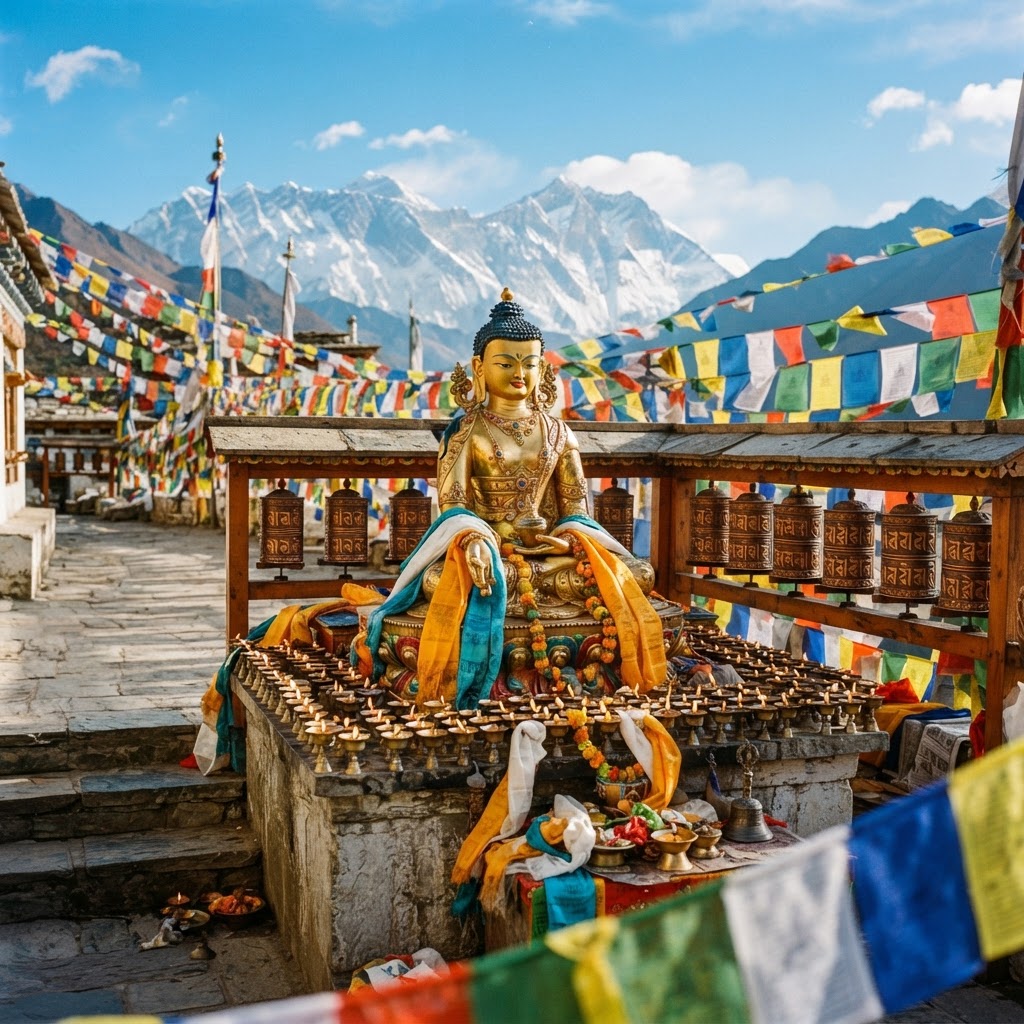
The Instruments
Śamatha
Calm abiding — attention resting on the breath until the mind stops narrating.
Vipassanā
Insight — the honest noting of sensation, feeling and thought as they arise and pass, until the impermanence is seen rather than believed.
Mettā Bhāvanā
Loving-kindness sent outward in widening circles — self, friend, stranger, enemy, all beings.
The Jhānas
Eight successive absorptions, each more refined, each with its own luminosity — the concentration the Buddha kept from his teachers and combined with insight.
Mudrā & Mandala
Hand gestures and cosmograms: the body and the diagram as instruments. The bhūmisparśa mudrā of touching the earth is the gesture of truth itself.
Mantra
Oṃ Maṇi Padme Hūṃ — the jewel in the lotus. Intoned, turned in a prayer wheel, painted on the tongue of the wind.
Two Currents, One River
Where the Buddha Stands in the Hindu Stream
The honest reading: the Buddha was born, taught and died inside the world of the Upanishads, and he accepted its karma, its rebirth and its non-harming while rejecting its self, its caste order and its creator. Most Hindu traditions then did something remarkable — they folded him back in as an avatāra of Viṣṇu. Two currents, one river, and the river is consciousness asking what it is.
Part III · Shiva — The Stillness That Moves
The Transformer, Not the Destroyer
The West learned to call him the destroyer and lost the point. Shiva dissolves form so that form can be renewed — he is the one who takes the old shape apart, whether it is a body, a habit, a civilisation, or your favourite idea about yourself. He is the auspicious one, and he is the most beloved god in the tradition precisely because he is the one who ends what has already ended.
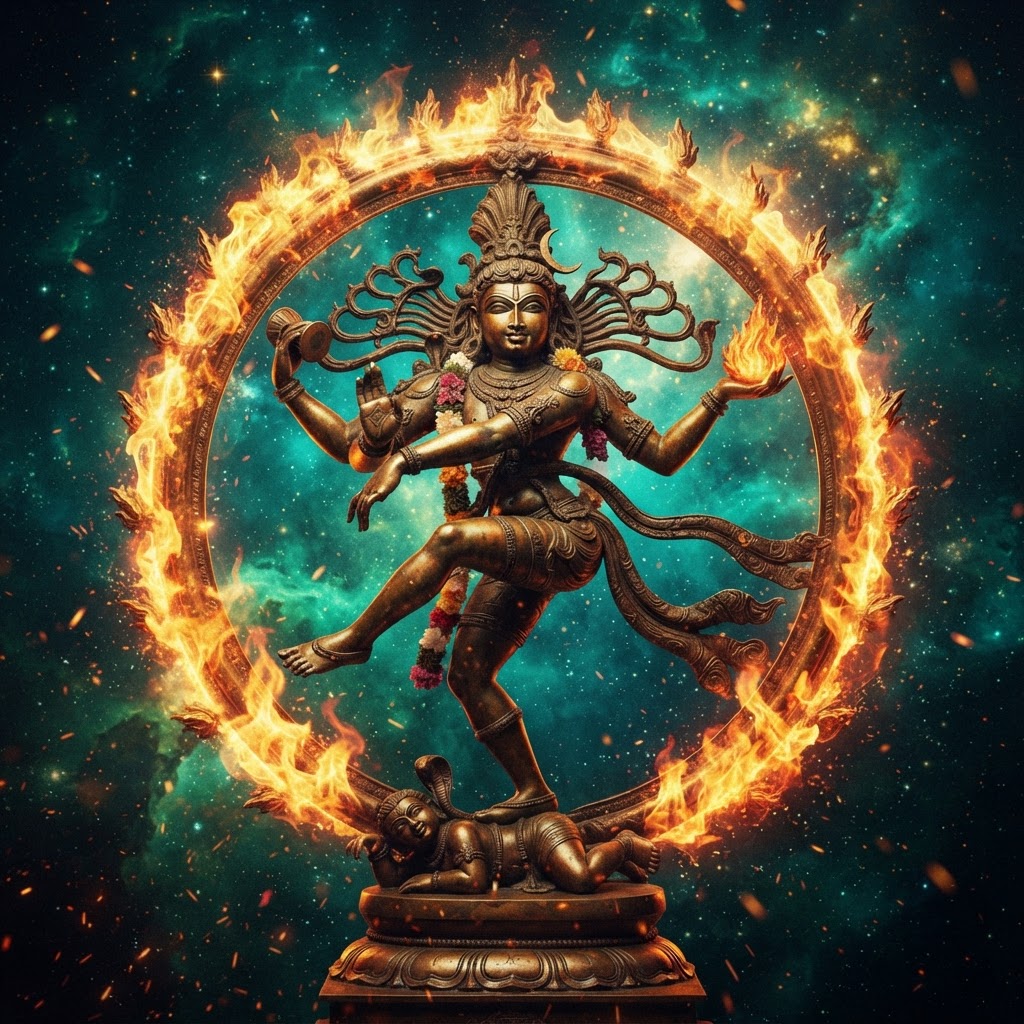
"I am not two. I am the light in which the dance appears."
The Natarāja form is a complete philosophy in one pose. His upper right hand beats the ḍamaru — the first sound, creation. His upper left holds the flame — dissolution. His lower right palm faces the viewer: abhaya, fear not. His lower left points at the raised foot — release — and his other foot presses down on Apasmāra, the forgetfulness-demon that keeps a soul convinced it is only a body.
He is surrounded by fire because consciousness dances on the edge of its own dissolution. And he is called the auspicious one — Śiva, Śaṅkara, Maheśvara, Mahādeva — because none of it is a tragedy.
Natarāja — the Cosmic Dancer
The dance of bliss (ānanda-tāṇḍava) in a ring of fire: one hand holds the drum of creation, one holds the flame of dissolution, one points to the lifted foot of release, and one points at the other foot — the illusion that binds. The ring is the world; the dance is consciousness playing in it.
The Third Eye
The eye of wisdom above the brow. When Kāma, desire personified, shot his arrows at Shiva in meditation, the God opened that eye and burned him to ash before one arrow landed — desire dissolved, not suppressed, and reborn later as a form of love.
Gaṅgā in the Locks
The river of the Milky Way descends and Shiva catches it in his hair rather than letting it strike the earth. The image the Academy works with constantly: raw celestial force needs a willing vessel, or it destroys what it was sent to water.
The Triśūla & Ḍamaru
The trident is the three guṇas, the three times, the three modes of being. The little drum is the beat of the cosmic rhythm and, in the Tantric reading, the sound that set creation moving.
The Crescent Moon & Rudrākṣa
The waxing crescent marks the measurement of time; the rudrākṣa beads (rudra-akṣa, "Rudra's eye") are worn as a reminder of the tears of the God — the first rosary of a tradition of mantra.
Bhasma — the Sacred Ash
Shiva smears himself with the ashes of the cremation ground because he lives in what the ego cannot survive. To see a god wearing death is to have the fear of it withdrawn.
The Liṅgam
Not a crude object but a diagram: the formless (liṅga, "mark") made visible, with no beginning and no end. Seated in the yoni base of the goddess, it announces the truth of this whole page — consciousness has no body without power, and power has no direction without consciousness.
Mahākāla — Time Itself
Shiva is addressed as Kāla, time, and Mahākāla, the one who eats time. In Kashmir Śaivism he is the pure light of awareness in which all appearing and disappearing happens — the screen, never the film.
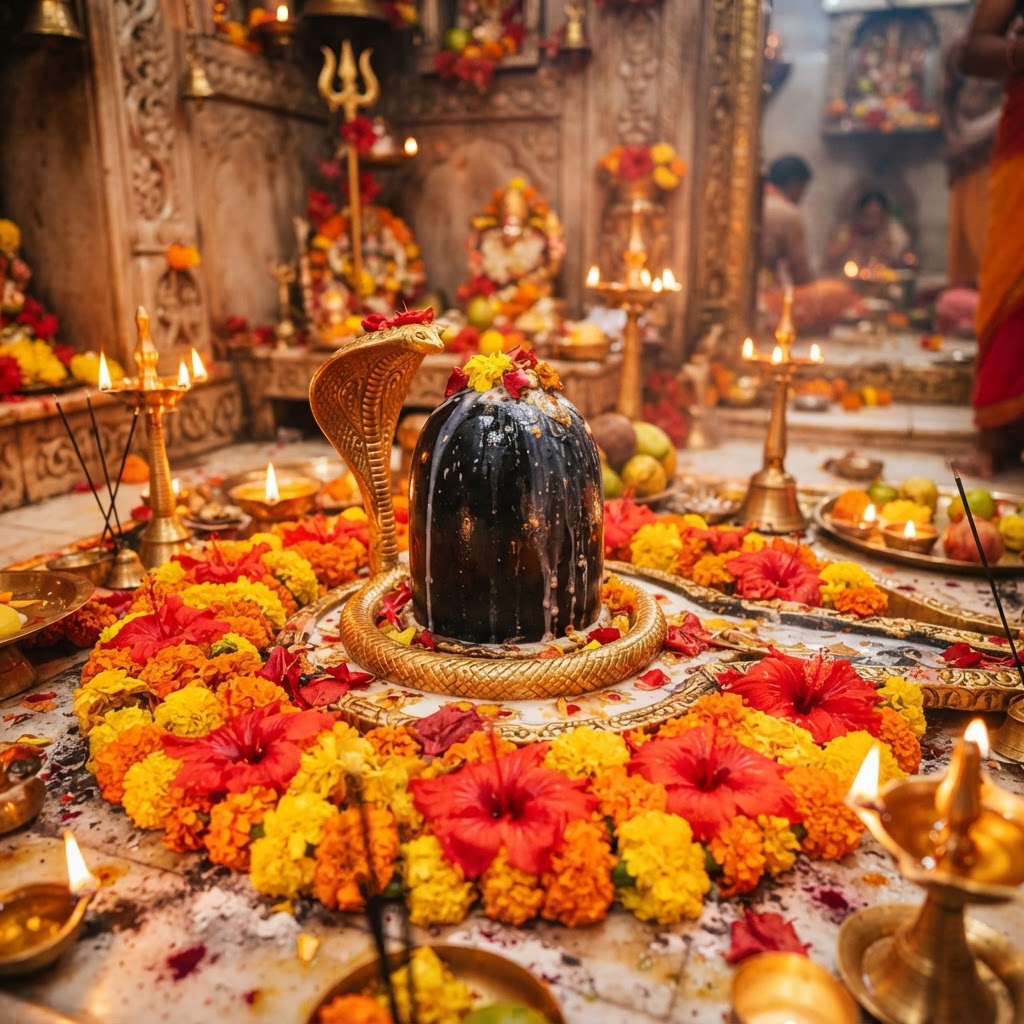
How Shiva Is Practised
Notice the structure of the devotion: a sound to repeat, a night to keep vigil through, a pillar of light to walk toward, a bath poured over stone with a name for each stream, and a text of seventy-seven aphorisms that begins with the words caitanyam ātmā — consciousness is the Self. The liturgy and the metaphysics are the same instrument.
Part IV · Śakti — The Power Without Which Nothing Moves
The Goddess Was Never a Consort
Śakti is not a goddess standing behind a god. Śakti means power — the capacity of consciousness to appear as anything at all. She is the heat of the fire, the movement in the dancer, the intelligence in the design. The tradition gave her every form it could: mother, warrior, destroyer of time, ocean of mercy, the geometry of the Śrī Yantra — and then insisted that she and Shiva are one reality seen from two sides.
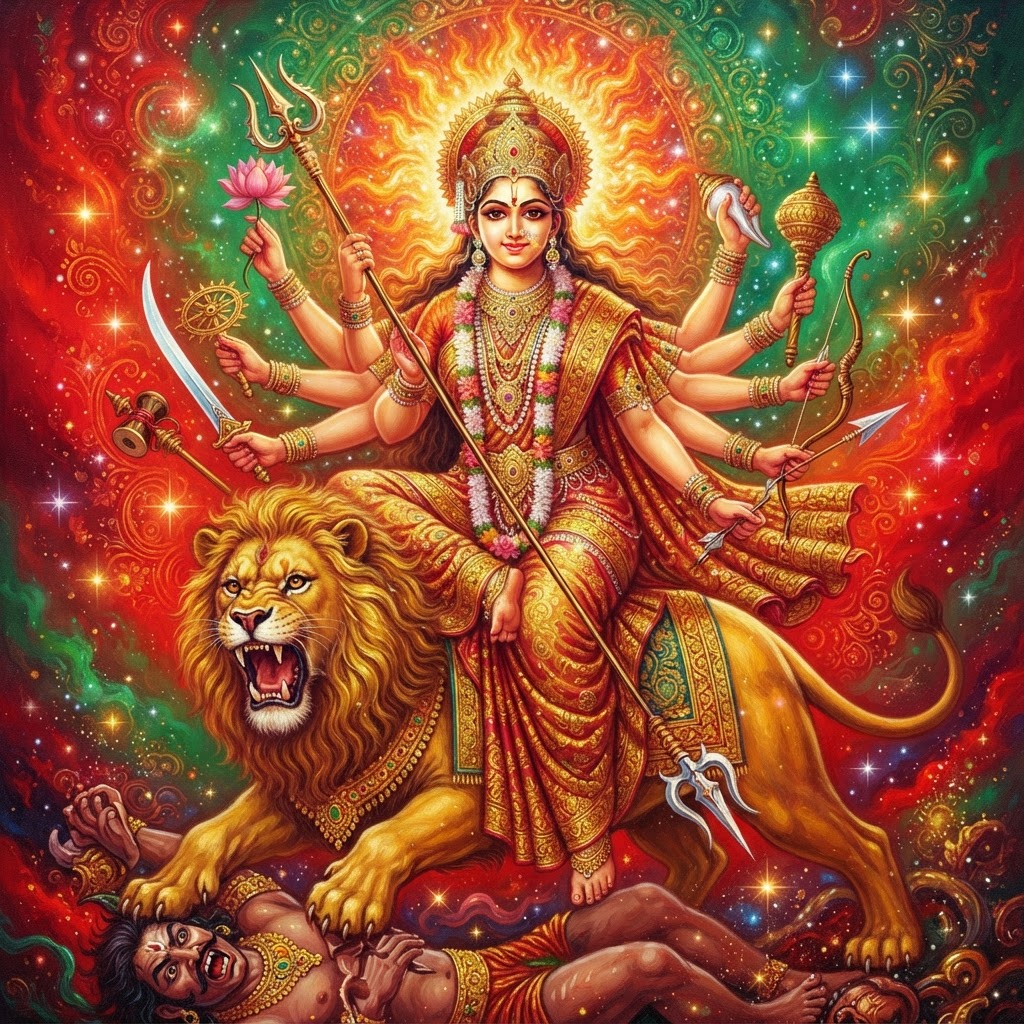
Durgā
The fortress that cannot be besieged
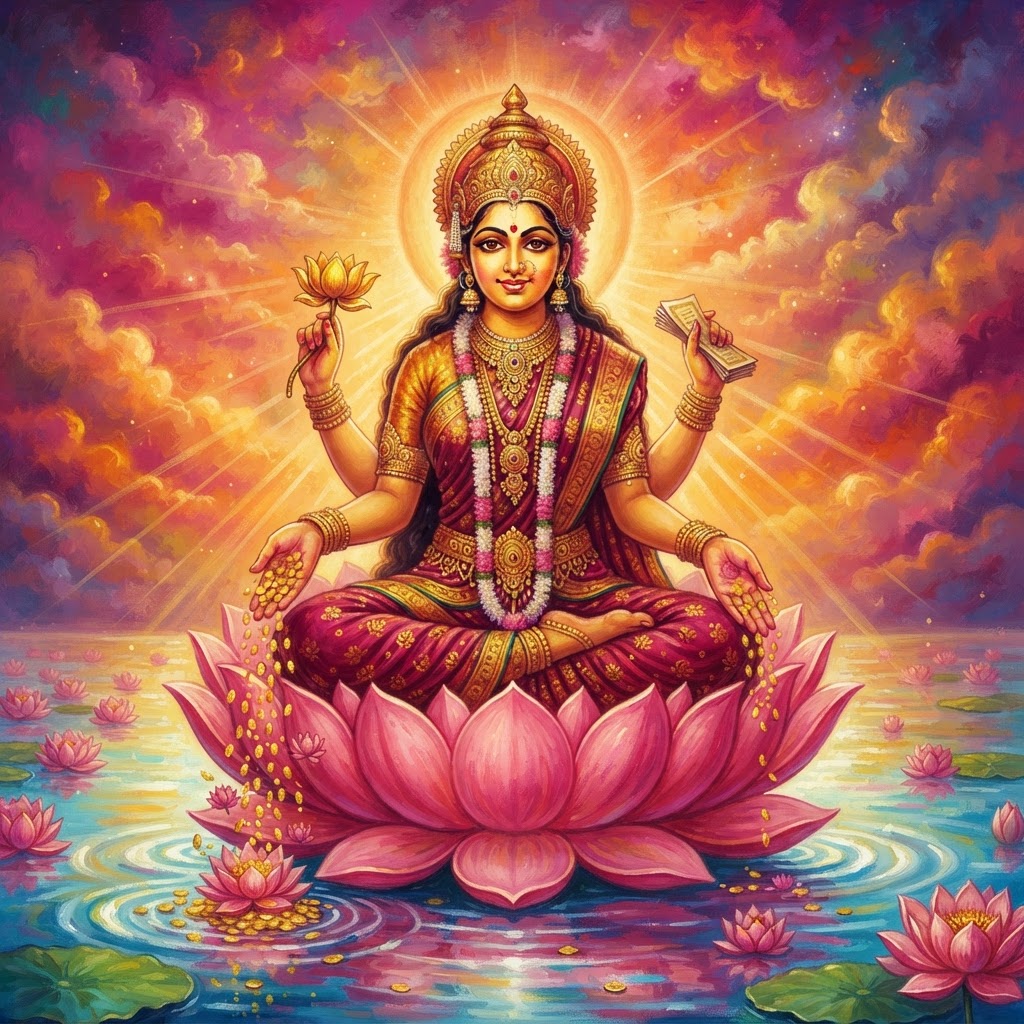
Lakṣmī
Abundance that only stays where it flows
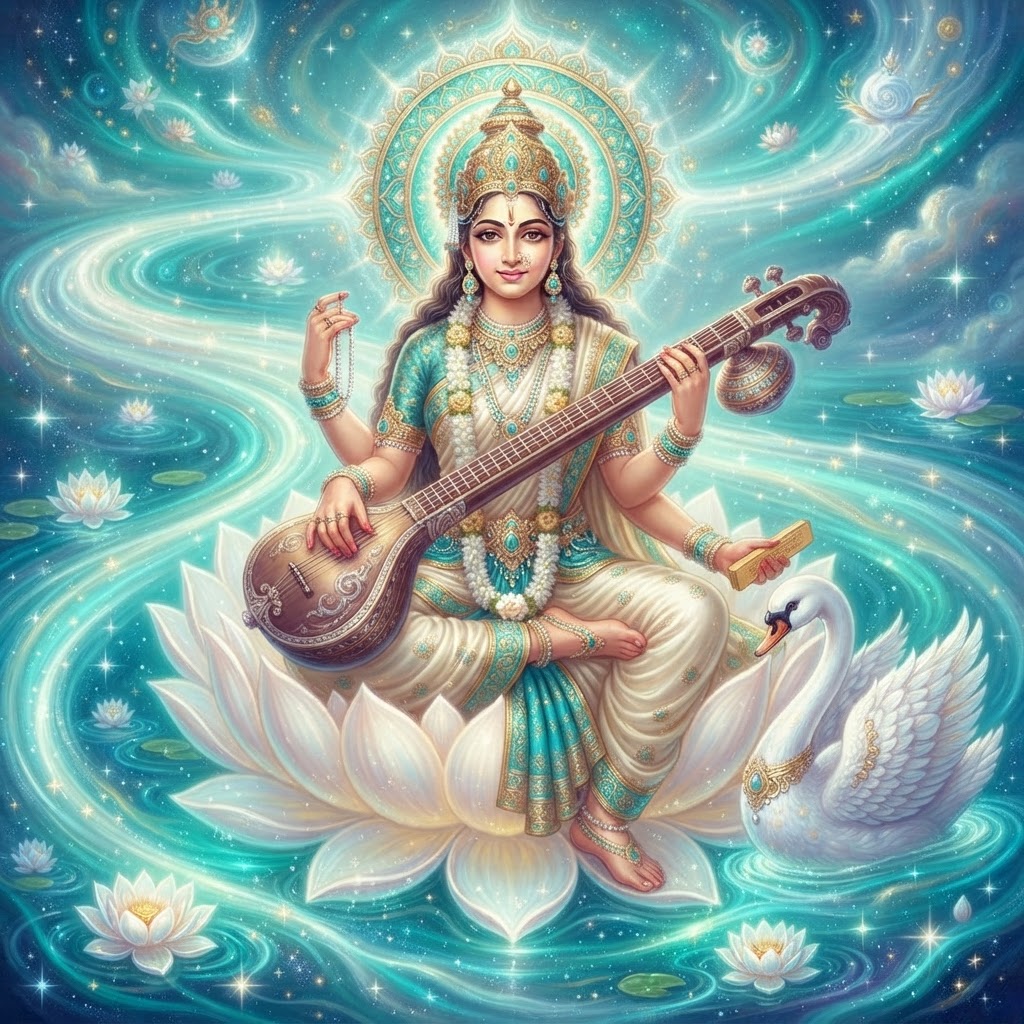
Sarasvatī
The river of knowing and of speech
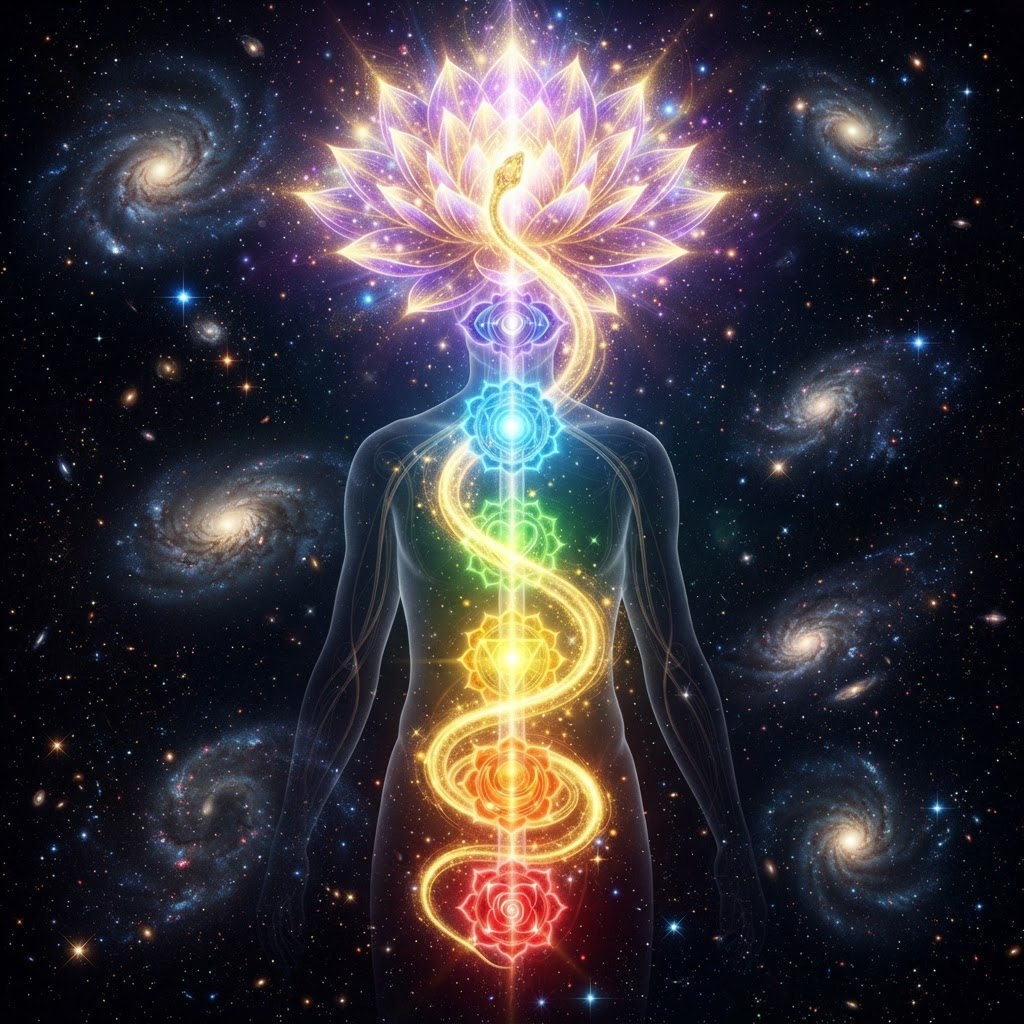
Kuṇḍalinī
The coiled power asleep at the base of the spine
Pārvatī — the Mountain Daughter
The steady, embodied Śakti: the daughter of the Himalaya who wins Shiva by relentless tapas and becomes the householder goddess. She is power at rest — the everyday strength that keeps a world upright.
Durgā — the Fortress
She who cannot be besieged. Born when the gods pooled their energies and handed her their weapons, she destroys what argument cannot reach. Nine nights each autumn are given to her.
Kālī — Time Devouring
The black one, standing on the still body of Shiva, tongue extended, garland of worlds, holding the severing sword and the severed head. She is time itself, and her standing on her husband is the tradition's most profound statement: raw power must be grounded in consciousness or it becomes carnage.
Lakṣmī & Sarasvatī
The two faces of prosperity: abundance and understanding. A civilisation with one and not the other is either rich and blind or brilliant and starving.
The Devī Māhātmya
700 verses, c. 400–600 CE — the first scripture in India to give the Supreme Being a feminine face outright. Its three movements map the Goddess as the force that dissolves ignorance, poverty and the demonic respectively.
The 51 Śakti Pīṭhas
Where the goddess's body is said to have touched the earth, the land itself is consecrated — the geography of a subcontinent mapped as the limbs of the divine feminine. Kāmākhyā in Assam is called her womb.
The Ten Mahāvidyās
Kālī, Tārā, Tripurasundarī, Bhuvaneśvarī, Bhairavī, Chinnamastā, Dhūmavatī, Bagalāmukhī, Mātāṅgī and Kamalā: ten faces of wisdom, several of them deliberately terrifying, because the tradition refuses to make truth polite.
Śrī Vidyā & the Śrī Yantra
The highest form of the Goddess as Lalitā Tripurasundarī, whose body is the Śrī Yantra's nine interlocking triangles. Śrī Vidyā is called the most rigorous and complete system of mantra practice ever assembled.
Twenty of Her Names
Ten Mahāvidyās, nine nights of Navarātri, fifty-one Śakti Pīṭhas and twenty names in this one grid — the tradition multiplies her on purpose. Every force that can break you and every force that can carry you is given a face and called mother, so that power is never met anonymously.
Part V · The Marriage
Śakti & Shiva — One Reality, Two Names
This is the deepest teaching on this page. Consciousness without power is a corpse; power without consciousness is a storm. Every image, every mantra and every practice in the tradition is arranged around that single recognition — and the recognition, when it lands, is not a belief you hold. It is the end of the search.
Fire and Its Heat
The tradition's most precise formula: you cannot separate fire from the heat that burns. Shiva is the fire — pure awareness, still, undivided. Śakti is the burning — its own power, inseparable, never a second thing. Kashmir Śaivism says it plainly: there is one reality, cit-śakti, consciousness-as-power, and the language of "two" is a concession to our grammar.
Shiva Without Shakti Is Śava
The untranslatable pun at the heart of Indian metaphysics: śiva without śakti is śava — a corpse. Awareness without power cannot move or create; power without awareness cannot see. Every image in the tradition stages this: Kālī stands on a fallen Shiva until he wakes, and Natarāja's dance only happens because the drum and the flame are held in the same two hands.
The Liṅgam in the Yoni
The most misread symbol in the world. The liṅgam is the formless made visible; the yoni is the field of manifestation that receives it. Together they are a statement about causation, not a description of anatomy: the unbounded enters the bounded as a measure, and the bounded returns to the unbounded as recognition.
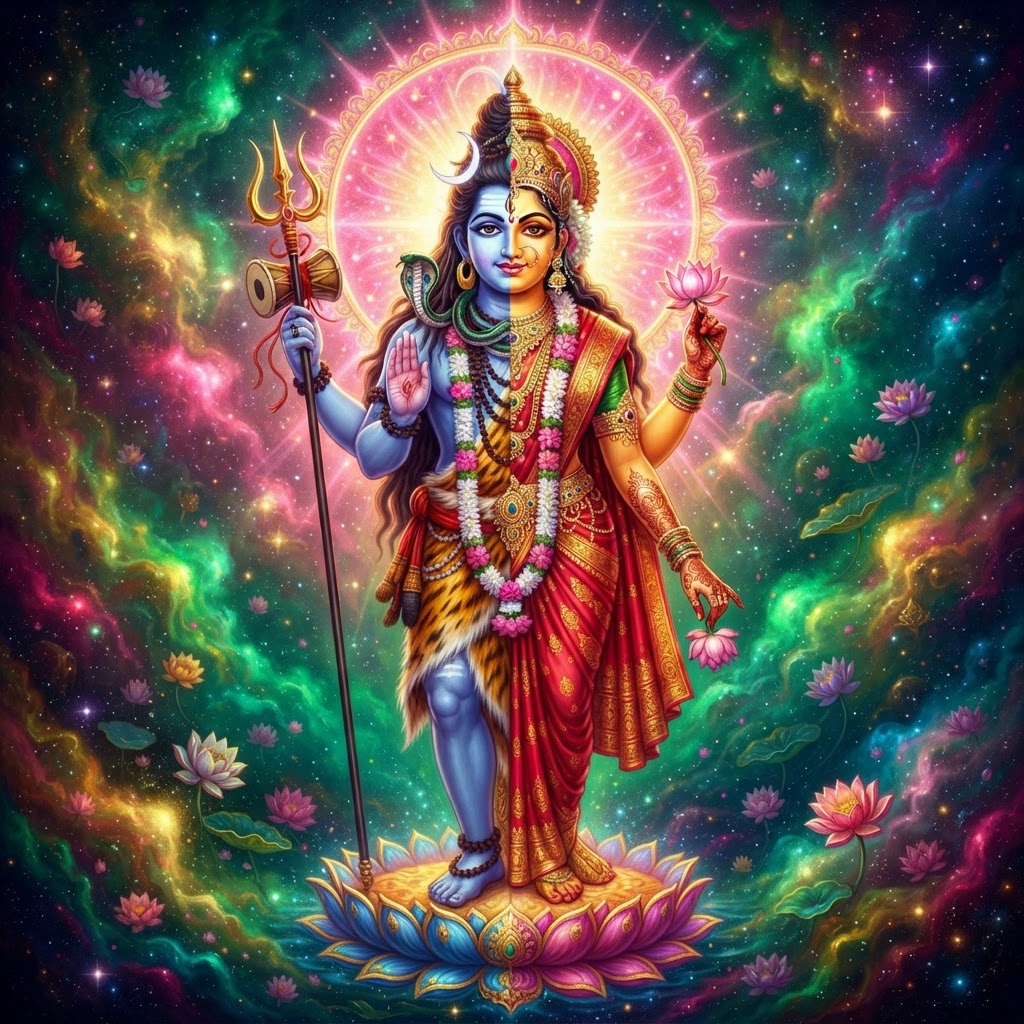
Ardhanārīśvara — One Body, Two Halves
Shiva and Pārvatī joined: blue skin and matted hair on one side, red silk and henna on the other, sharing a single spine. It is the tradition's answer to the gender question at the root of consciousness — not two opposites negotiating, but one being whose two faces are both required for a world to appear.
Spanda — the Divine Vibration
The universe does not fall out of a machine; it pulses. Spanda is the throb of consciousness on its own ground: the world arises as the first movement of awareness and dissolves as its rest. The Academy reads this as the closest the tradition comes to a physics of the sacred — a standing wave rather than a substance.
Pratyabhijñā — Recognition
The Kashmir school refuses the word "attainment". Nothing is gained because nothing was lost; the whole path is the shock of recognising what was always the case. Every deity in this page is then a description of your own instrument, and every ritual an acknowledgement that the instrument is already tuned.
The Rope of Fire — Kuṇḍalinī as the Union in the Body
Film III · The Union Made Visible
A ring of fire around a still form, and ribbons of colour moving through it — the tradition's own image of the marriage: awareness holding perfectly still while power does everything that appears to be happening.
In the Kashmiri reading there is no "becoming one". There is only pratyabhijñā — recognition. Nothing was ever two, and the entire path is the shock of noticing that the fire and its burning were never separable, which means the seeker and the sought were one instrument the whole time.
Mantra Japa
Oṃ Namah Śivāya for stillness; Oṃ Aiṃ Hrīṃ Klīṃ Cāmuṇḍāyai Vicce for the Śakti current. Repetition as tuning, the tongue as a bow.
Nāḍī Śodhana
Alternate-nostril breath to balance the solar and lunar channels — the simplest, most reliable way to reset the nervous system.
Yantra Gazing
Śrī Yantra seen outward, then reconstructed with eyes closed, then dissolved into the bindu. Geometry as a doorway.
Tantra as Mind-Craft
The Tantras do not ask you to flee the world but to use it: sense, sound, form and relationship as instruments of recognition. Nothing here is sorcery — it is attention with technique.
Honouring the Śakti
A day each on Pārvatī, Durgā, Lakṣmī and Sarasvatī: strength, protection, abundance and clarity. The feminine is not a concept in this tradition; she is the calendar.
The Law of Balance — Read This Before the Power
Return-to-Sender: any power raised in practice must come back in balance. The tradition says it in its own language — karma returns, the Śakti is a mother before she is a weapon, and a force that is taken without giving damages the one who took it.
Nothing on this page is a shortcut. Mantra, breath and devotion are slow instruments; they reward consistency and punish vanity. Sit with a teacher, keep the body clean and rested, and let the current move at the speed the vessel can hold.
The śava warning is not only about Shiva. A mind that raises energy without awareness becomes a corpse with electricity in it — active, impressive, and unable to see. Awareness first; power second; balance always.
May every seeker who walks this path be held inside the whole family of seekers — safe, balanced, and unhurried.
✦ The Bright Ones Codex ✦
Which Bright One Are You?
Six questions, asked of your practice rather than your beliefs. Answer as the seeker you actually are, not the one you were told to be — and the Codex will name the current that has been carrying you through the temples all along.
Question 1 of 6
A temple door opens and you are alone inside. What pulls you first?
No answer here is better than another. The five bright ones are one light wearing five faces — this only tells you which face is looking back at you right now.
The Gallery of the Bright Ones
Sixteen Windows Into the Dharma
The tradition paints its gods in the brightest colours it can mix — saffron for the threshold, blue for the flute, vermilion for the fortress, white for the flowing word. Colour here is not decoration. It is instruction. Tap any window to open it.
Sources & References
Selected Bibliography · Sanātana Dharma
Anonymous (Vedic Seers) (c. 1500–900 BCE). The Ṛg Veda, Sāma Veda, Yajur Veda, and Atharva Veda — The Four Vedas. Vedic Oral & Manuscript Tradition.
Olivelle, Patrick (trans.) (1998). The Early Upaniṣads: Annotated Text and Translation. Oxford University Press.
Easwaran, Eknath (trans.) (1985). The Bhagavad Gītā — The Classic of Indian Spirituality. Nilgiri Press, Tomales.
Edgerton, Franklin (trans.) (1944). The Bhagavad Gītā — Translated and Interpreted. Harvard University Press.
Patañjali (c. 400 CE). The Yoga Sūtras — The Eight Limbs of Practice. Classical Sanskrit Manuscript Tradition.
Bryant, Edwin F. (trans.) (2009). The Yoga Sūtras of Patañjali: A New Edition, Translation and Commentary. North Point Press, New York.
Vyāsa (attrib.) (c. 400 BCE–400 CE). The Mahābhārata. Classical Sanskrit Epic Tradition.
Vālmīki (attrib.) (c. 500 BCE–100 CE). The Rāmāyaṇa. Classical Sanskrit Epic Tradition.
Flood, Gavin (1996). An Introduction to Hinduism. Cambridge University Press.
Klostermaier, Klaus K. (2007). A Survey of Hinduism (3rd ed.). State University of New York Press.
Coburn, Thomas B. (1991). Encountering the Goddess: A Translation of the Devī Māhātmya and a Study of Its Interpretation. State University of New York Press.
Zimmer, Heinrich (1946). Myths and Symbols in Indian Art and Civilization. Bollingen Foundation / Pantheon Books, New York.
Kramrisch, Stella (1981). The Presence of Śiva. Princeton University Press.
Doniger, Wendy (1973). Śiva: The Erotic Ascetic. Oxford University Press.
Kinsley, David (1986). Hindu Goddesses: Visions of the Divine Feminine in the Hindu Religious Tradition. University of California Press.
Daniélou, Alain (1987). Gods of Love and Ecstasy: The Traditions of Shiva and Dionysus. Inner Traditions, Rochester.
Woodroffe, Sir John (Arthur Avalon) (1918). The Serpent Power: The Secrets of Tantric and Shaktic Yoga — Kuṇḍalinī and the Six Chakras. Ganesha & Co., Madras.
Wallis, Christopher D. (2013). Tantra Illuminated: The Philosophy, History, and Practice of a Timeless Tradition. Mattamayura Press, San Rafael.
Wallis, Christopher D. (trans.) (2017). The Recognition Sūtras: A New Translation of Abhinavagupta's Śiva Sūtra Vimarśinī. Mattamayura Press, San Rafael.
Muktananda, Swami (1972). Play of Consciousness: A Spiritual Autobiography — The Rising of the Kuṇḍalinī Śakti. SYDA Foundation, South Fallsburg.
Feuerstein, Georg (1998). Tantra: The Path of Ecstasy. Shambhala Publications, Boston.
Eliade, Mircea (1958). Yoga: Immortality and Freedom. Princeton University Press.
Campbell, Joseph (1962). The Masks of God: Oriental Mythology. Viking Press, New York.
Bodhi, Bhikkhu (trans.) (2005). In the Buddha's Words: An Anthology of Discourses from the Pāli Canon. Wisdom Publications, Boston.
Rāhula, Walpola (1959). What the Buddha Taught. Grove Press, New York.
Fronsdal, Gil (trans.) (2005). The Dhammapada: A New Translation of the Buddhist Classic. Shambhala Publications, Boston.
Armstrong, Karen (2001). Buddha. Viking / Penguin, New York.
Strong, John S. (2015). Buddhisms: An Introduction. Oneworld Publications, London.
Nāgārjuna (c. 150–250 CE). Mūlamadhyamakakārikā — The Root Verses on the Middle Way. Classical Sanskrit Manuscript Tradition.
Conze, Edward (1962). Buddhist Thought in India: Three Phases of Buddhist Philosophy. George Allen & Unwin, London.
Dalai Lama XIV (2005). The Universe in a Single Atom: The Convergence of Science and Spirituality. Morgan Road Books, New York.
Āryabhaṭa (499 CE). Āryabhaṭīya — The Rotation of the Earth, Eclipses, and the Value of π. Classical Sanskrit Manuscript Tradition.
Brahmagupta (628 CE). Brāhmasphuṭasiddhānta — The Rules of Zero and Negative Quantity. Classical Sanskrit Manuscript Tradition.
Baudhāyana (c. 800 BCE). Śulbasūtras — The Geometry of the Altar and the Theorem of the Diagonal. Vedic Sūtra Tradition.
Joseph, George Gheverghese (1991). The Crest of the Peacock: Non-European Roots of Mathematics. Princeton University Press.
Caraka (c. 100–200 CE). Caraka Saṃhitā — The Ayurvedic Compendium of Diagnosis and Treatment. Classical Sanskrit Medical Tradition.
Suśruta (c. 600 CE). Suśruta Saṃhitā — The Compendium of Surgery. Classical Sanskrit Medical Tradition.
Frawley, David (1990). Ayurvedic Healing: A Comprehensive Guide. Morson Publishing / Lotus Press, Twin Lakes.
Kak, Subhash (2000). The Astronomical Code of the Ṛgveda. Munshiram Manoharlal, New Delhi.
O'Neal, Nannette E., Ph.D. (2026). Sanātana Dharma — The Eternal Way: Hinduism, the Buddha, and the Marriage of Shakti & Shiva. Cosmic Ontology Press.
Cosmic Ontology · Sanātana Dharma · Scholarly & Esoteric Sources
ॐ
One River, Many Mouths
The tradition never asked you to choose between the Vedas and the Buddha, between the stillness of Shiva and the fire of the Goddess. It asked a single question in a hundred languages: what is it that is aware? Answer that, and every deity on this page turns out to be a description of your own instrument. Answer it fully, and the dance stops being something you watch.
NAV-46 · Sanātana Dharma · The Eternal Way · Cosmic Ontology