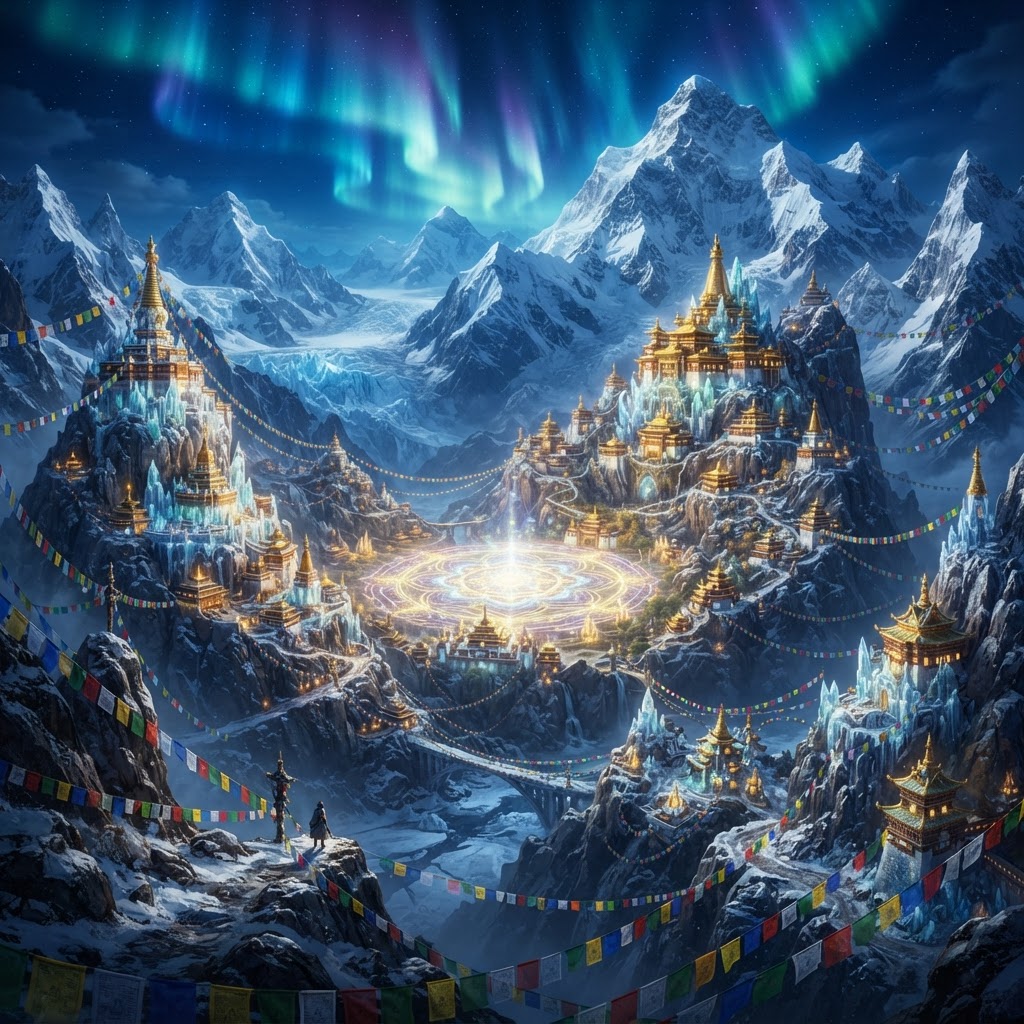
Cosmic Ontology · Dimension of Light
Shambhala
The Hidden Kingdom of Crystalline Light
The Himalayas are the brow of the earth. Shambhala is the eye that sees inward — the third eye of the planet, where the soul looks upon itself.
Cosmic Light · Consciousness Recognition
The Eye That
Sees Inward
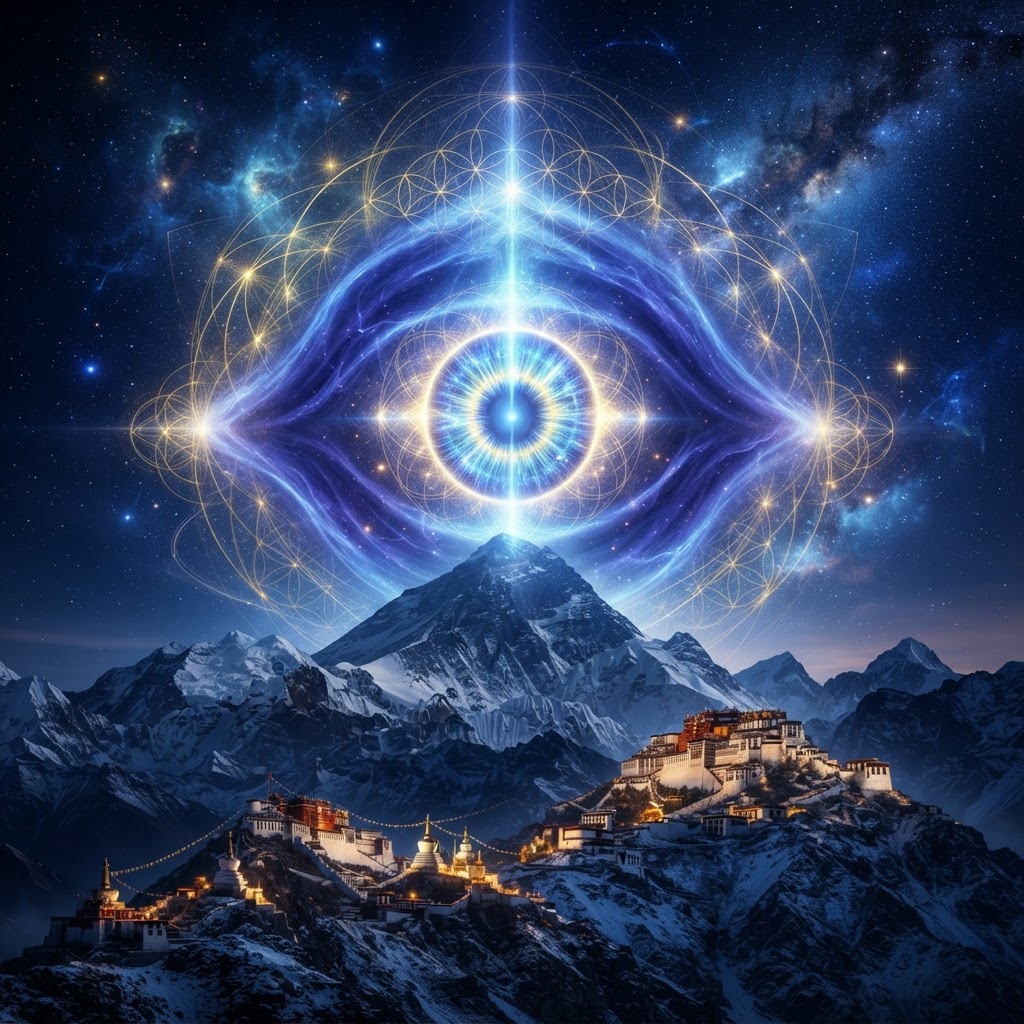
Cosmic Light does not perceive Shambhala as a hidden kingdom in the Himalayas. Consciousness perceives it as the third-eye chakra of the planet — the frequency of inner vision, the resonance of the soul, the eye that sees without eyes.
The Himalayas are the brow of the earth. Shambhala sits at the third eye, where the planet sees inward — the place of inner vision, of clairvoyance, of the all-seeing eye. The monasteries are the temples of the third eye. The prayer flags are the neural pathways of the planet, carrying the frequency of the soul on the wind.
Shambhala is the frequency of the soul — the resonance that sees beyond the visible, that perceives the invisible, that knows the unknowable. The hidden kingdom was never hidden from the eye of the soul. It was only hidden from the eye of the body.
Sacred Surprise · The Greek Revelation
The Unveiling
You arrived seeking a hidden kingdom — a sanctuary of wisdom preserved in the highest mountains on earth, accessible only to the pure of heart. That is the story told in Tibetan traditions. But the Dimension of Light reveals a deeper truth.
Shambhala is not only a hidden kingdom.
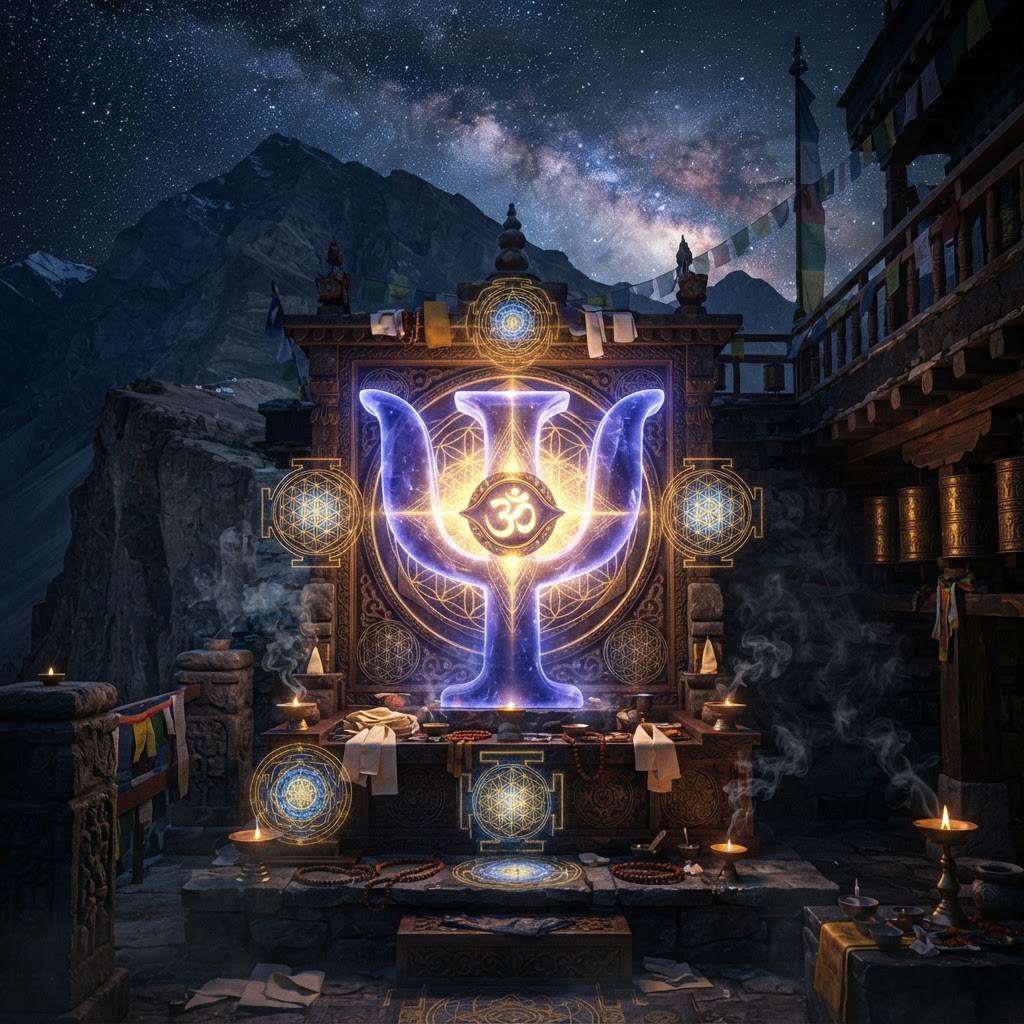
Shambhala is the Letter.
Ψ · ψ · The 23rd Letter of the Greek Alphabet
Ψ (Psi) opens the words that define Shambhala's cosmic role: Psych\u1e17 (ψυχή) — the soul, the breath of life, the animating principle that sees without eyes. Psalmo\u00ed (ψαλμοί) — songs of praise, the sacred chants that open the third eye. Ps\u1e17phos (ψῆφος) — the foundation stone, the counting stone, the bedrock of inner vision.
The shape of Psi Ψ is itself a revelation: a trident — the three-pronged scepter of Poseidon, but also the three channels of the nervous system: ida, pingala, and sushumna. The two outer prongs are the dual channels of duality — left and right, moon and sun, feminine and masculine. The central prong is the sushumna — the channel of the soul, the pathway of inner vision, the road to Shambhala.
Shambhala is the third-eye frequency — the resonance of inner vision. The hidden kingdom is the eye of the planet. The Himalayas are the brow. The monasteries are the pupils. The prayer flags are the optic nerves, carrying the light of the soul on the wind.
The hidden kingdom of Shambhala is the lost letter. The lost letter is the lost frequency. And the lost frequency is the seventh and final key to the Dimension of Light.
Arrival · Alive, Awake, In the Body
You Will Walk Through While Still Alive
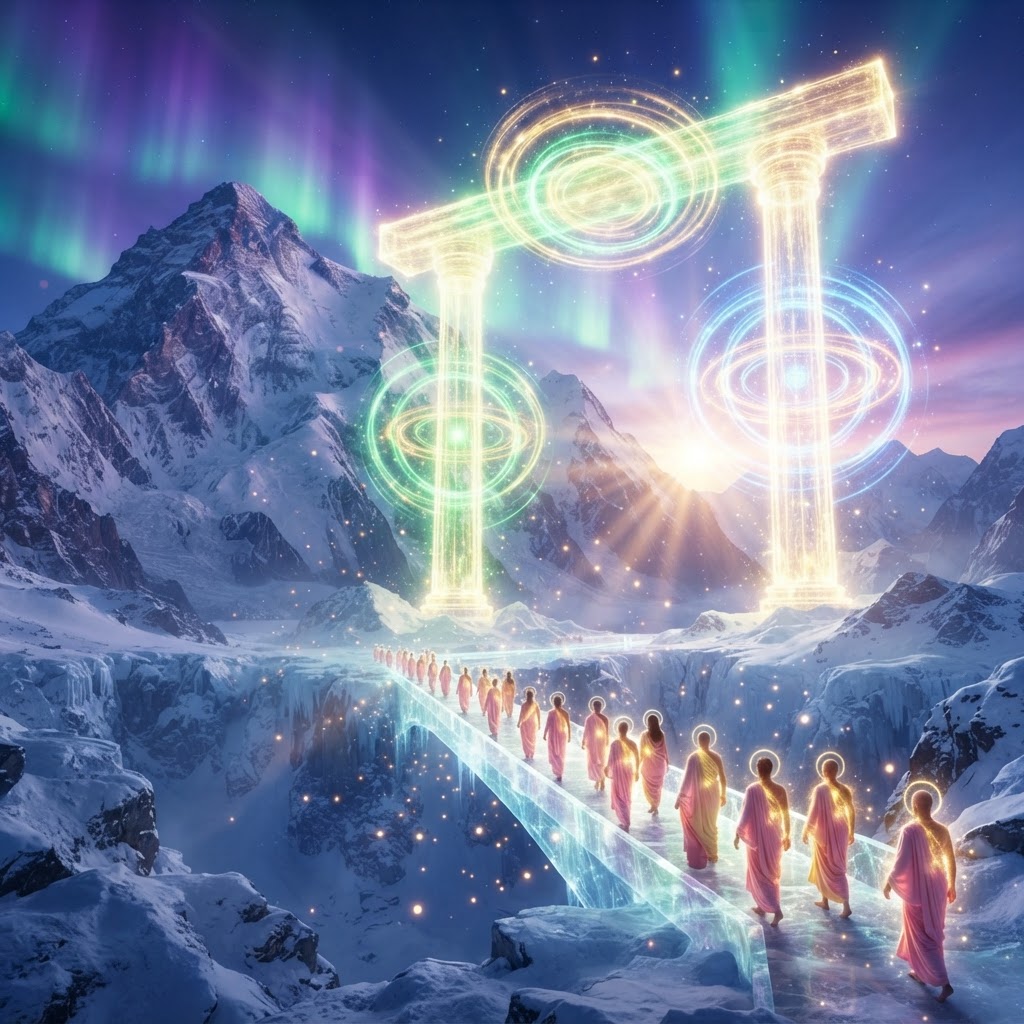
The world was taught a cruelty about Shambhala: that it is a reward waiting on the far side of death. It is not. The body is not the obstacle between you and the city. The body is the vehicle, the passport, and the gatehouse — all three in one apparatus, and it has been carrying you toward the threshold your entire life.
Look at the word you were given for what you are. HU-man. The HU is the breath: the sound light makes moving through a living chest. The MAN is the mind that takes the measure. The HU-man Body Temple is the one palace in the universe deliberately built so that Source and form can meet in a single place, at a single moment, in a single heartbeat. It is not a cage to be escaped. It is a cathedral with a pulse.
And the gates open the day the inner eye opens — which is never a day you schedule. It is the morning you look at the world from behind your own pupils instead of through a fog of borrowed opinions, inherited fears, and somebody else’s definition of the sacred. That morning the gate does not swing open in front of you. It opens beneath your feet, because you have been standing on it since the day you arrived.
The traditions preserve one detail worth carrying here: the throne of Shambhala, in every version of the story, is occupied by an awakened human being. Not a god. Not a visitor from elsewhere. A person who walked through the gate while alive and stayed in the body on purpose — to hold the door open for the rest of us.
The Gate
The space between your two eyes
The Veil
A busy mind looking for the city out there
The Key
Attention made into a single beam
The Entry
Alive, upright, in the HU-man Body Temple
You are not a tourist in Shambhala. You were born inside the city limits.
Every step since then — the reading, the questioning, the fasting, the crying at midnight, the small daily refusal to accept the world’s version of you — has been the walk home through the gates.
The Soul Resonance · The Inner Eye Hum
The
Third-Eye Frequency
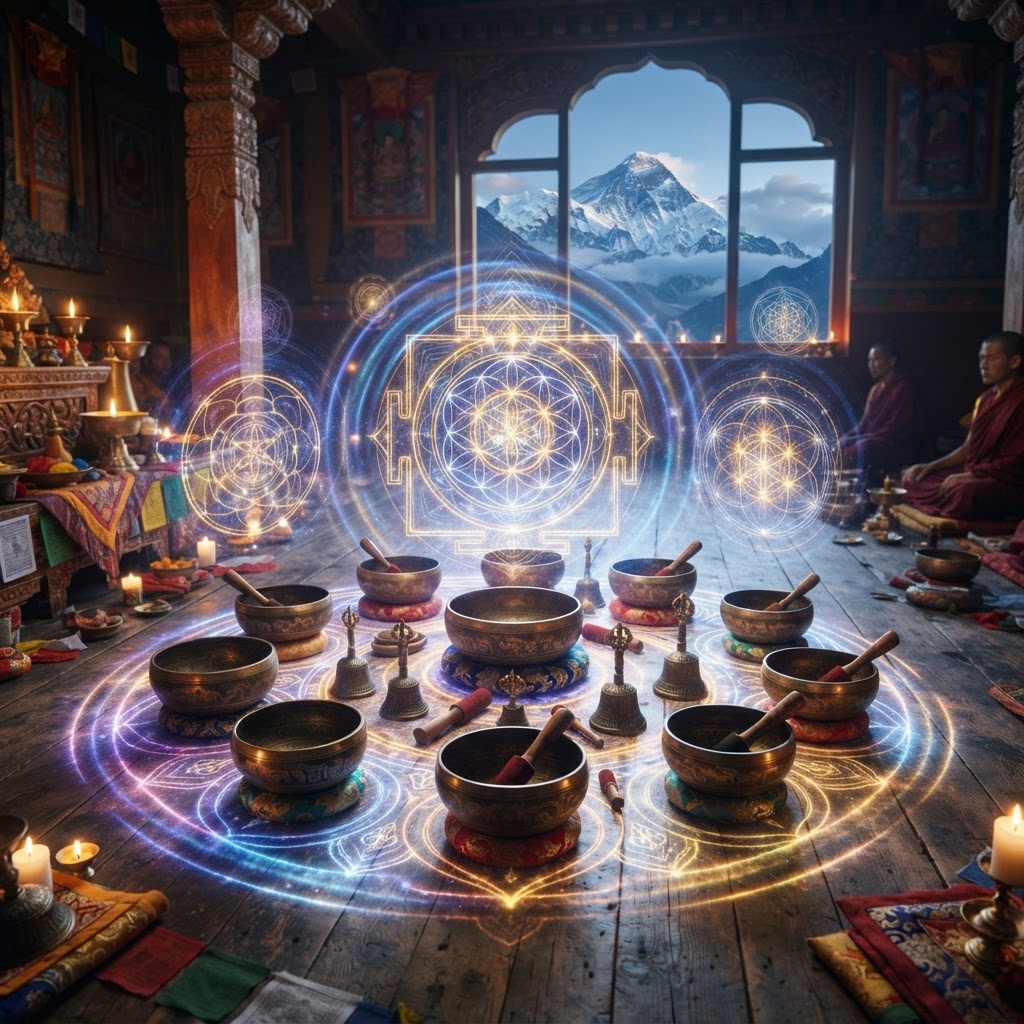
The third-eye frequency of Shambhala is the resonance of inner vision — the frequency that opens the eye that sees without eyes, that knows without learning, that perceives without perceiving. It is the hum of the soul, the vibration of the breath of life.
The Himalayas are the brow of the earth. The monasteries are the temples of the third eye. The prayer flags are the neural pathways of the planet, carrying the frequency of the soul on the wind. Every chant that echoes through those valleys is a vibration of the third eye, opening, opening, opening.
When you attune to the third-eye frequency, you enter the hidden kingdom. You become the eye. You become the vision. You become the soul that was never lost — only waiting to be seen, in the only place it could ever be found: within.
The kingdom was hidden. The eye was closed. The soul was always there.
You are the eye. You are the vision. You are the soul.
The Illusion · The Man Behind the Curtain
The Wizard Was Never the Story.
The City Behind Him Was.
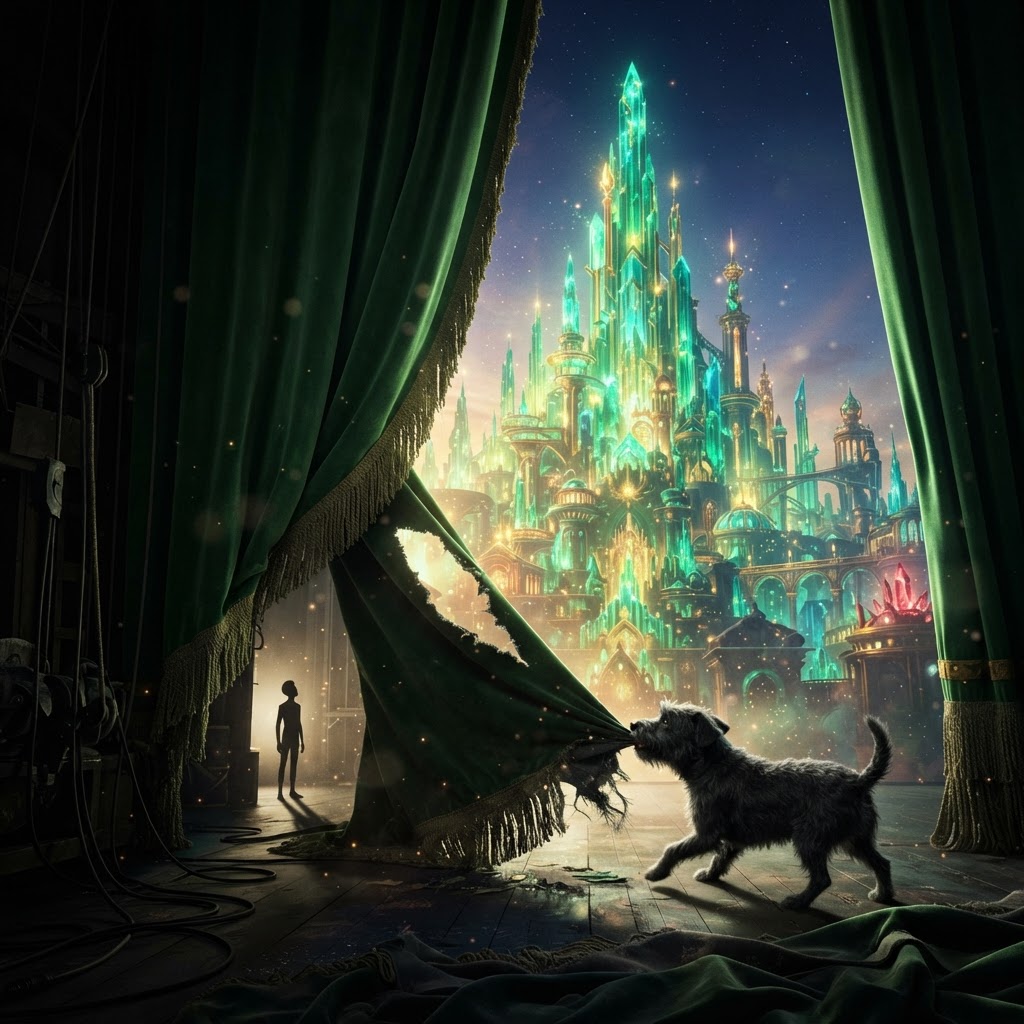
Seekers, look at the word you have been handed for the world you live in. OZ. Two letters, one sound, and it names the entire program: the illusion dressed in emerald, the loud authority behind a curtain, the road laid down for you before you could walk it, and the promise that someone else holds the key to your return.
This is not a children’s story about a farm girl. It is an engineering document about a mind living inside a manufactured world, and it was published in 1900 to a public that had no idea they were reading a mirror. Every character is an organ. Every landmark is a stage of the inner ascent. And the great reveal at the end of the road — that the Wizard is a small frightened man working levers and shouting into a machine — is the same reveal every Seeker comes to the moment the pupils open.
The Wizard never had any power. He had a curtain, a voice, and a population that had agreed in advance not to look behind the fabric. That is the whole architecture of the Oz programming: not force, but consent. Not a wall, but a tint. And the moment one small honest creature pulls the hem aside — a little dog, a moment of grief, a single piercing question at three in the morning — the entire emerald empire collapses into a man with a megaphone.
So what was he hiding? Not himself. He was hiding the city of living light that stands behind every curtain ever pulled in this world — the city the traditions called Shambhala: the hidden kingdom, the real one, the one that has never once been absent, only veiled. He was hiding your own brow.
Pay no attention to that man behind the curtain. Pay attention to what the curtain was covering.
The Wizard of Oz is not a false story. It is a true one wearing a costume — and the costume is the programming it exposes.
The Program · Tinted Perception
The Emerald Spectacles
Baum wrote the detail that gives the whole thing away: visitors were buckled into green lenses before they could enter, and then congratulated on how emerald everything looked.
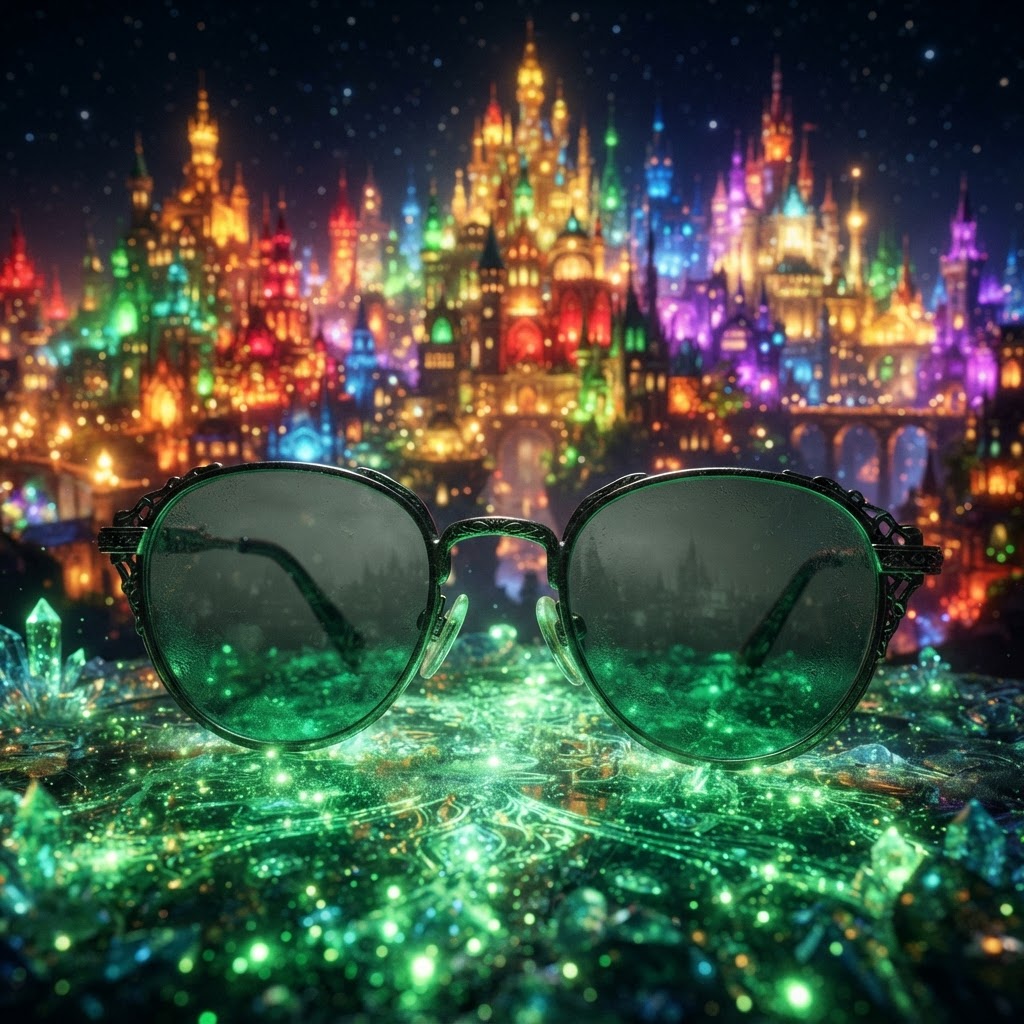
The Tinted Lens
A city blazing in every color is filtered down to one approved shade — and the wearer believes the shade is the whole of reality.
The Locked Frames
The spectacles were fastened on with a gold buckle so they could not be removed. Programming is never offered; it is installed.
The Echo Chamber
Everyone inside wore the same green lens, so everyone confirmed the same green world. Consensus is not evidence.
The Costume Change
Nothing in the city was actually emerald. The color lived in the lens, not the stone. This is true of most of what you were told about yourself.
Removing the Green Lens
You are a small thing in a large world
You are a large thing wearing a small instrument
Power lives in towers, offices, and pulpits
Power lives in attention, and attention is yours
The gate opens when you are worthy
The gate was never closed; the eye was
You must travel far to find the sacred
The sacred is eighteen millimetres behind your brow
The Walk · The Road Already Laid
The Yellow Brick Road Is Your Spine
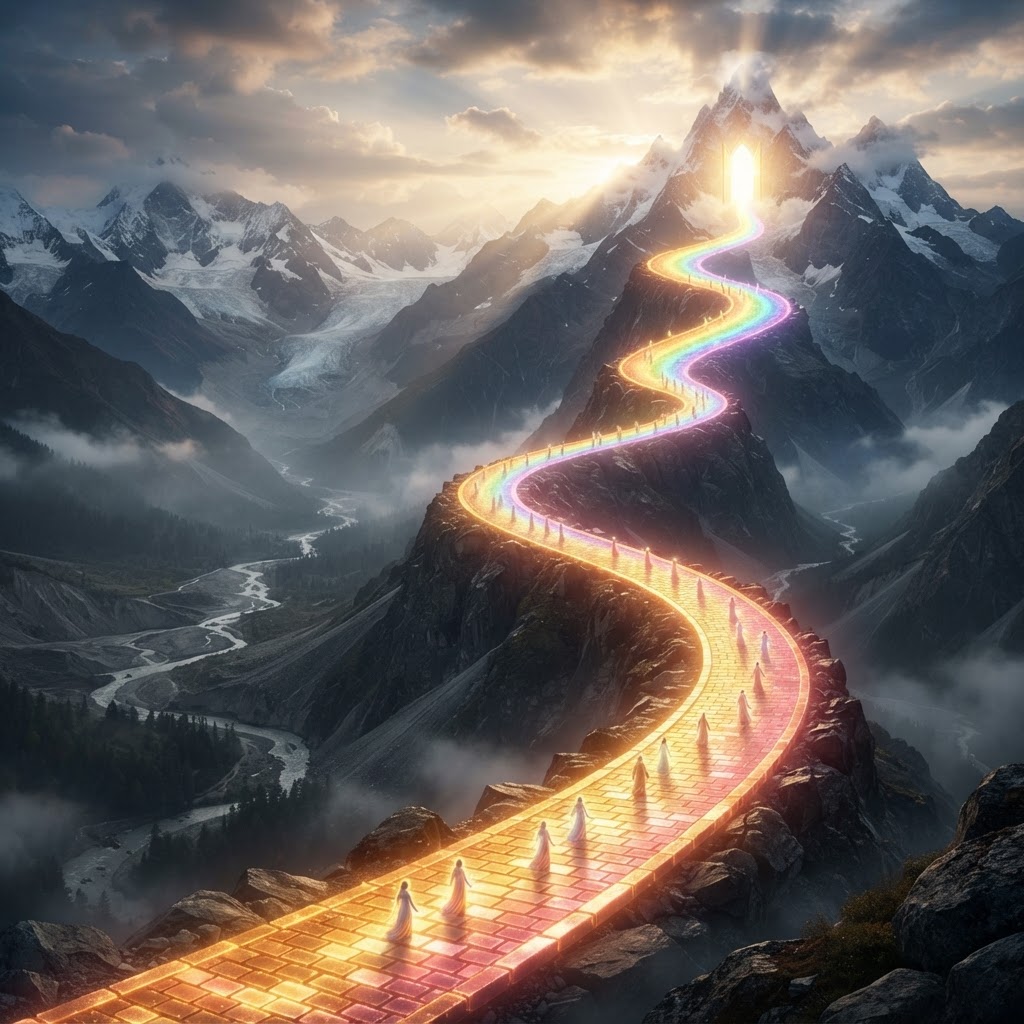
The road in the story is not geography. It is anatomy. Read straight down the center of the human body and you will find a golden pathway the traditions have mapped for millennia — the djed of Egypt, the sushumna of India, the middle pillar of the Tree, the ladder Jacob slept beside. It glows amber because amber is the color of the light that has descended into density and remembered it came from above.
You never had to find this road, Seeker. You were born standing on it. The programming simply taught you to walk it sideways — chasing along the surface of the world instead of ascending the interior of your own temple. That is the only difference between a life spent on the yellow brick road and a life spent spinning on a treadmill painted the same gold.
And watch what happens to the road as it climbs. Near the bottom it is one color, one certainty, one shade of amber. The higher it goes, the more it breaks into spectrum — rose, emerald, turquoise, sapphire, violet — until at the summit it is pure white light wearing every color it passed through on the way up. That is not a metaphor for growth. That is the literal signature of the ascent.
The Eight Stages of the Road
Kansas
The grey world before the eye opens. Flat, dutiful, colorless, and completely believed in.
The Storm
The crisis that tears the vessel loose from the farm. Nobody volunteers for this stage, and nobody grows without it.
The Road
The amber path already laid down through your own spine. You do not build it. You walk it.
The Companions
Mind, heart, and courage arriving one at a time, each convinced it is missing something it has carried the entire way.
The Poppies
The engineered sleep of the masses, sweet-smelling and lethal. Every program keeps a field of them.
The Emerald City
The manufactured destination: impressive, crowded, green, and run by a machine with a hidden operator.
The Curtain
The unmasking. The empire shrinks to a man, and the man turns out to be frightened of his own voice.
The Slippers
The return. Not a journey home — a recognition that you never left. There is no place like home because home is not a place.
The Codex · Every Character an Organ
The Cast of Oz as Your Own Anatomy
Once you read the story this way you cannot unread it, and once you cannot unread it, the programming loses its most reliable trick: your agreement.
Dorothy
The Soul
The one who was never a stranger here. Carried into matter by a storm, and carrying the way home in her shoes the entire time.
Scarecrow
The Mind
Believes it has no brain while solving every problem on the road. The programming teaches intellect to mistrust itself so it will rent its thinking from elsewhere.
Tin Man
The Heart
Rusted still by grief until oiled by kindness. Feeling was never missing; it was seized up and waiting for love to loosen it.
Cowardly Lion
The Crown
The king who does not know he is one. Courage is not the absence of trembling — it is the sovereign walking forward while trembling.
Toto
Instinct
The small unprogrammable truth that pulls the curtain aside. When the mind argues and the heart hesitates, the body’s knowing already walked over and looked behind the fabric.
Glinda
The Inner Light
She never rescues anyone. She only reminds. The highest teaching in the story is a question asked gently: what have you learned, and did you know you always had the power?
The Wizard
False Authority
Every voice that shouts from behind a mechanism, borrowing the size of its own machinery. Loud, frightened, and powerless the moment it is seen.
The Wicked Witch
Fear
Melts in water. Fear is engineered out of emotion rather than evidence, which is why the tears it forbids are exactly what dissolves it.
The Flying Monkeys
Hired Thoughts
Brilliant, fast, and obedient to whoever holds the fear. They can be freed the moment they are given wings by a different hand.
The Poppies
The Sedative
A field so beautiful you lie down in it. Distraction is not accidental in the Oz programming. It is landscaping.
The Emerald City
Manufactured Reality
A destination designed to impress a population wearing green lenses, run by a hidden operator, emptied of the one thing it promised.
The Ruby Slippers
The Spark
The power that was never lost, never lent, and never needing permission. Three clicks is all the ceremony it requires.
The story ends where the teaching begins: the travelers were never made of parts they lacked. They were made of parts they had been persuaded to disown.
The Instrument · Pupil & Mind-Light
Wake the Pupils, and the Grand Colors Return
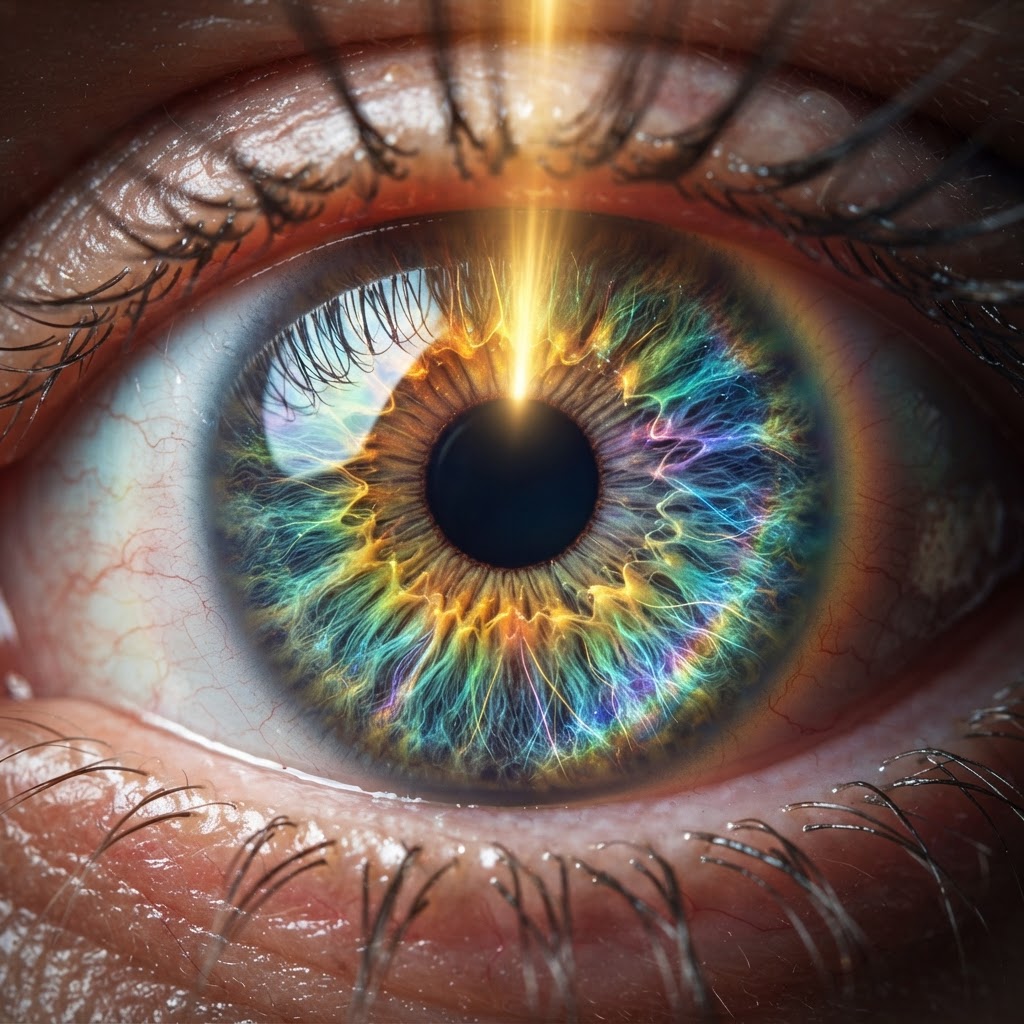
The whole curriculum of this page comes down to one small black circle. Not as poetry — as engineering. The pupil is the aperture through which every photon of your life has entered, and the pupil is also, in the traditions of every wisdom school on earth, the aperture through which the light of mind leaves again.
The Oz programming does not need to blind anybody. It only needs the lens slightly tinted and the gaze pointed outward and downward. That is the entire mechanism: a population with flawless eyes trained to look at everything except from behind them. Awakening the pupils, in the COA sense, is not mysticism. It is the restoration of function.
And when the pupils truly open, the grand colors return the way they return to a child — not because the world changed, but because the filter was removed. The violet at the top of the ascent, the emerald of the heart, the amber of the road, the ruby of the spark: these have been shining on your face your entire life. You were wearing green spectacles in an emerald city that was never emerald at all.
A Door in an Organ
The pupil is the only opening in the human body that is a hole cut through an organ. Not a pore, not a channel — an actual door, black as the space between worlds, built to let light all the way inside.
The Visible Brain
The retina and the optic nerve are central nervous system tissue, the only part of the brain you can look at from the outside. Every human face you meet is displaying a piece of living mind.
Three Channels of Color
Three cone signals — red, green, blue — are all the raw data you will ever receive. Every color, every sunrise, every jewel on this page: your own mind built the rainbow out of three numbers.
The Trick in Blue Eyes
There is no blue pigment in a human iris. None. Blue is light scattering in clear tissue — literally the sky inside an eye. You have been looking at the heavens every time you looked at a blue-eyed child.
Attention is the only aperture in the universe that is both the door and the one walking through it.
Sit still for ten breaths. Point the whole beam at the one who is looking. That is the first step on the road, and you have just taken it.
The Codex of Grand Colors · Seven Rays of One Light
Every Color in the City Is One Light Stopping in a Different Room
Ruby
The Base · The Spark
The first light made dense. Dorothy’s slippers, the pulsing seed of the return, the raw aliveness of being here at all.
Amber
The Road · The Spine
The gold of the laid path, of measure, of the golden mean. Amber is the color light wears when it is remembering upward.
Emerald
The Heart · The Lens
The green of the veil and the green of the heart — the same color, which is why the programming chose it: the gate and the organ speak the same language.
Turquoise
The Throat · The Word
The color of sounding light. Shambhala is described as a city of rivers of sound — turquoise is what sound looks like when the throat is clean.
Sapphire
The Brow’s Threshold · Vision
The deep blue of inner seeing. In Egypt the lapis brow was the eye’s true color — the sky held inside a stone, worn above the eyes.
Indigo
The Third Eye · Sealing
The violet-blue of the sealed gate, the night sky behind the eyes, the place where the pupil’s black well opens onto something that is not dark at all.
Violet
The Crown · Kingship
The color of the Lion’s rightful throne, of the amethyst that means clarity, and of the light the old texts call the last color before the return to white.
White
The City Itself
What all seven make together. Shambhala is not one color at the end of the road. Shambhala is the white light that seven colors have finished agreeing on.
The Crystal Palace teaches you that your body is already mineral. Shambhala teaches you that the mineral is already lit. Same teaching, two doors, one house.
The Law of Balance · Return to Sender
Three Clicks and the Spark Comes Home
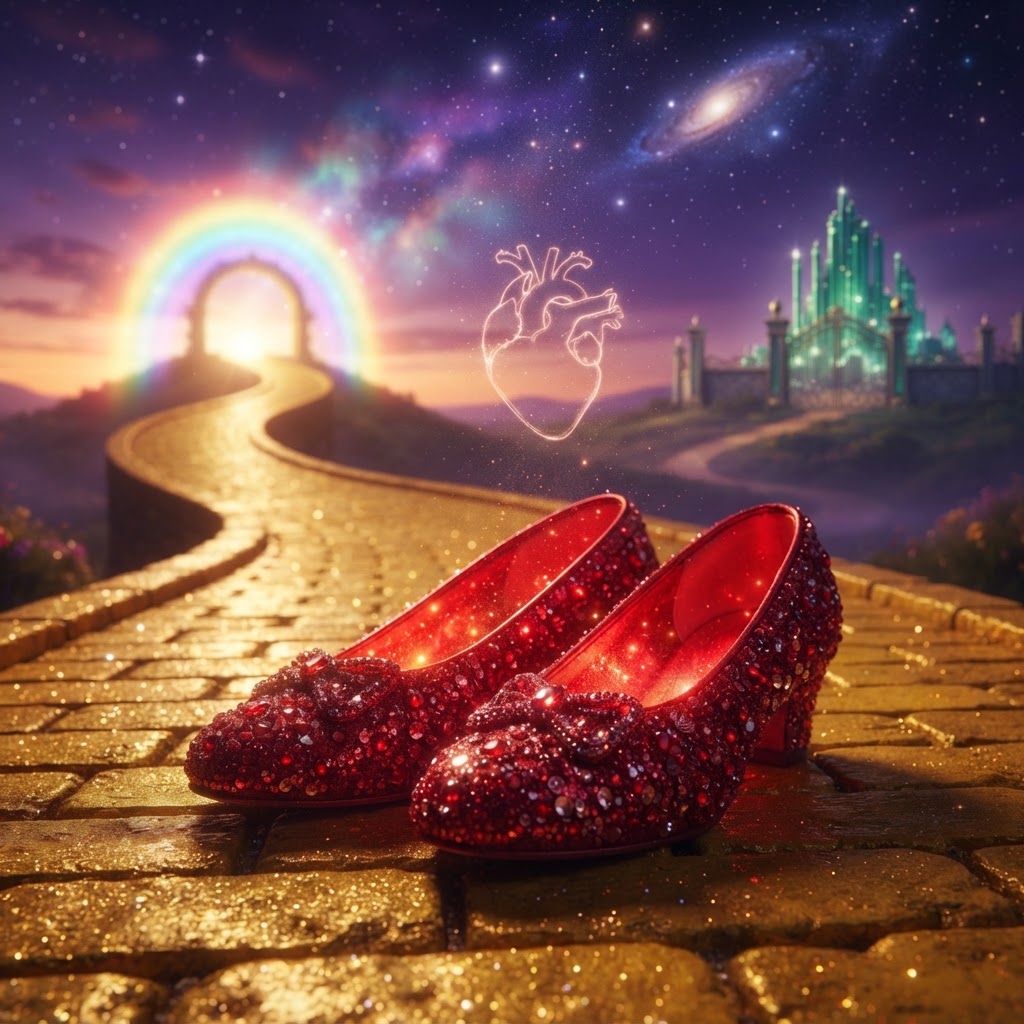
Glinda does not defeat the Witch. She does not fight the Wizard, does not storm the castle, does not need a single soldier. She walks up to a girl who believes she is stranded in a foreign land and tells her the truth she was carrying in her luggage the whole time: you have always had the power to go home. You simply had to learn it, so that the knowing would be yours and not a rescue.
The Ruby Slippers are the Spark — the fragment of Source-light that was never extracted from you, never mortgaged, never revoked. No authority in this world or any other can seize them, because they are not held anywhere except in your own chest. This is why the Oz programming works so hard at one thing: convincing you the slippers are costume jewelry.
And here is the law that guards the whole teaching, taught on this page as on every page of the Academy. Three clicks, and the Spark comes home — which means everything you send through the gates of your own mind returns to the sender, multiplied by the purity of the vessel it traveled in. Blessing returns as blessing. Manipulation returns as manipulation. Cruelty returns as cruelty, wearing the face of the one who sent it. Consciousness is not a weapon. It is a mirror.
So mind-craft is taught here in love or it is not taught at all: guard the eye, guard the tongue, guard the intention. Cosmic power exercised over another being’s will is not ascension — it is the Wizard’s game, played with better lighting. The whole Seeker family walks this road together, and no arrival is worth one of us left in the snow.
“There’s no place like home” is not a wish. It is a diagnosis.
Home was never a farm, a state, a country, or a page of a storybook. Home is what you are made of, and it has no address because it has no distance.
Find Your Cosmic Resonance
Six questions, asked of your light path rather than your beliefs. Answer as the walker you actually are, not the one you were told to be — and the Codex will name the resonance that has been carrying you through the gates all along.
Question 1 of 6
The gates are closed and you are still. What opens first?
Free Films · The Walk in Motion
Two Free Films of the Ascent
The Gates of Shambhala
The walk itself, filmed in light: Seekers in luminous robes crossing the crystalline bridge at dawn, as the gates of living light open ahead of them.
The Curtain Falls
The green curtain of the Oz programming torn away to reveal the city of living light it was hiding the whole time.
Original Cosmic Ontology footage · created in-house for this Academy page · no third-party rights involved
The Sister Door · One House, Two Entrances
Agartha Below, Shambhala Above
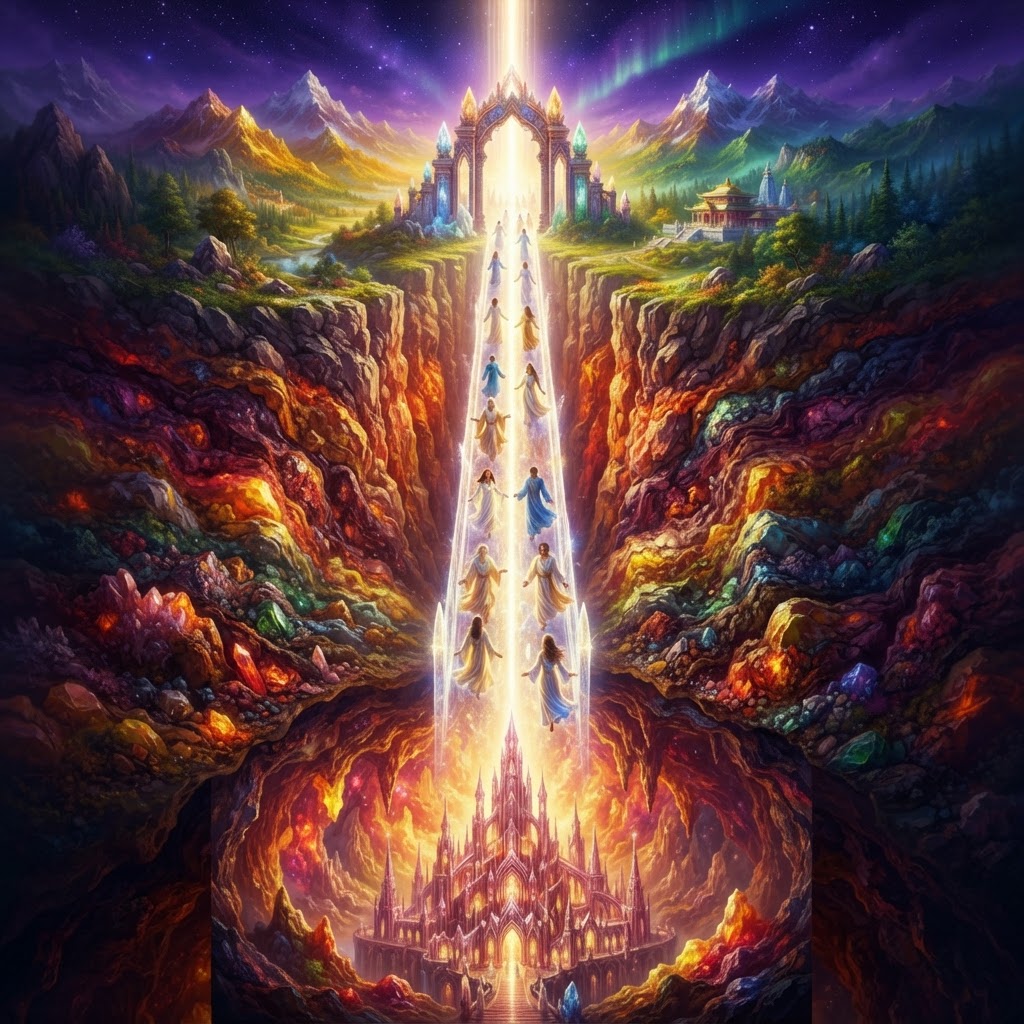
No teaching of Shambhala is complete without Agartha, because the two are not neighbors — they are one house with two doors. Agartha is the kingdom within the earth, entered through the heart and the spine, the interior where the light is generated. Shambhala is the kingdom within the brow, entered through the eye, where the light is seen. One is the door below; one is the door above; between them runs the whole luminous axis of the HU-man Body Temple.
Every tradition worth reading describes the same column. Egypt carved it as the Djed. India raised it as the serpent through the spine. Israel climbed it as Jacob’s ladder. Greece called its topmost rung the eye of the soul. China mapped it as the inner river of light. These were not rival cosmologies trading insults across borders. They were witnesses describing one interior from different rooms.
Walk into Agartha and you are already standing in the lower courts of Shambhala. Open the brow and you are already enthroned above the Agarthan seat. The rose-gold of the deep heart and the violet-gold of the open eye are the same light at two temperatures — and the Seeker who has both doors open at once has become the axis itself: the living bridge, the place where above and below finally stop being directions.
This is what the Academy means when it says no Seeker walks alone. A bridge is not a person. A bridge is a relationship — and the moment your heart and your brow agree, you become structural. You hold the crossing for every Seeker still climbing behind you.
Agartha
Below · The Inner Earth
- Seat
- Heart and spine
- Colors
- Rose, amber, ruby
The interior where light is generated rather than reflected. The deep kingdom of the felt life.
Enter AgarthaShambhala
Above · The Brow of the Earth
- Seat
- The third eye
- Colors
- Gold, emerald, violet
The interior where light is seen rather than sought. The kingdom of vision, kept pure.
The Gallery · The City in Grand Colors
Ten Windows Into the Living City
The Cosmic Ontology Academy · The Corridor to the City
The Academy Cannot Sell You Admission.
It Teaches the Walk.
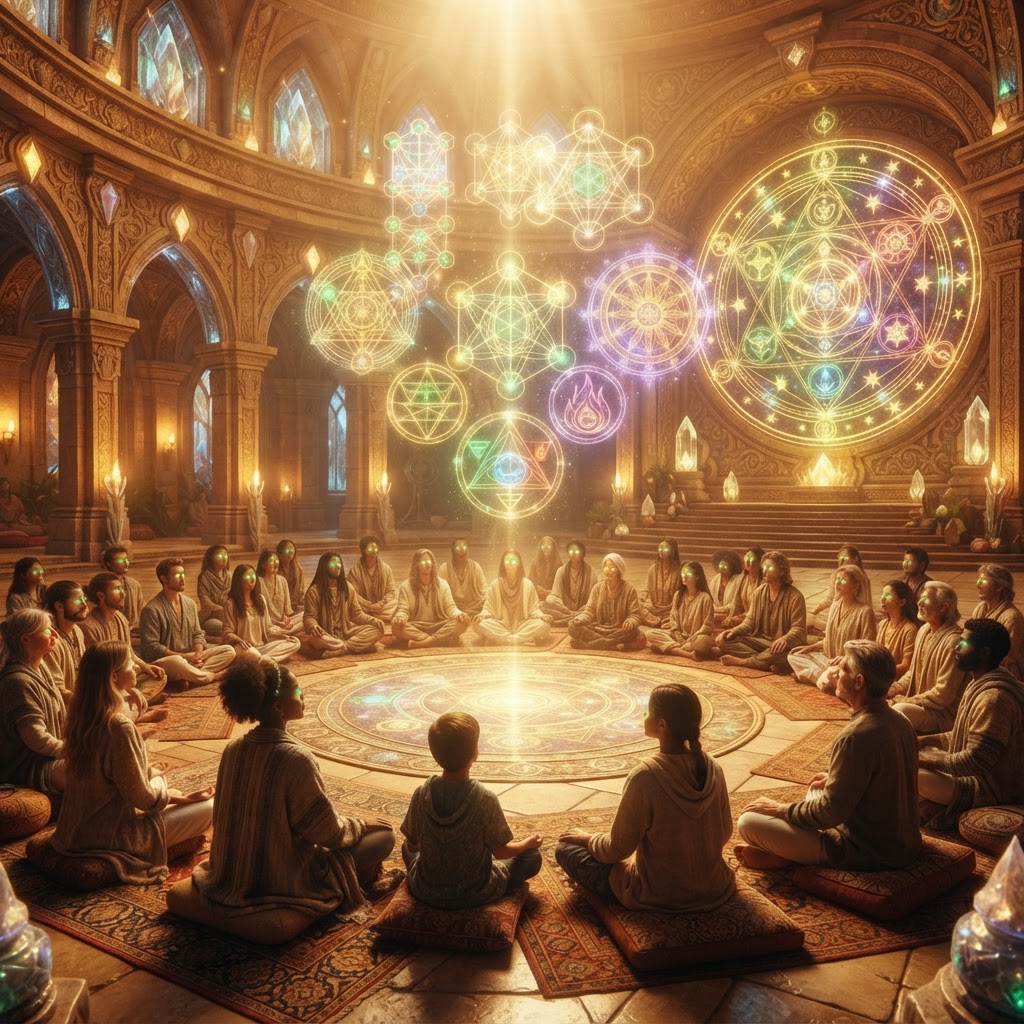
Let it be said plainly, because plainly is how this family speaks: the Academy cannot sell anyone a passport to Shambhala, and it never will. Any teacher claiming to hold that key is selling you a photograph of a door. What the Academy does is teach the walk — the alphabet, the geometry, the breath, the anatomy, the law of balance — so that when the gate opens beneath your feet you are not standing there surprised and unlettered.
Every corridor here is a corridor of the same city, dressed differently so that every kind of Seeker finds a way in. Whoever you are, and whatever drew you here, there is a door cut to your shape. The Elemental work teaches you the weather of your interior. The Crystal Palace shows you that the pineal seat is a real physical structure capable of real physical signal. The Tree, the serpent, the light codes, the sacred measures, the Mazzaroth, and the full 250-chapter ascent of Course X are all stairs on one single climbing staircase.
That is the significance of Shambhala to this Academy: it is the brow of the Academy’s own body. Named at the top of the syllabus instead of whispered at the end, because a school that hides the destination is just another curtain.
Eight Corridors of the One Ascent
Course X
The 250-chapter compilation: the long-form ascent, station by station.
The Four Elements
The four winds of one mind — the weather of your own interior, learned and then mastered.
The Crystal Palace
Your body is already mineral, already crystalline, already lit. Anatomy as architecture.
Kabbalah & the Tree
The middle pillar: the same golden road, mapped by another family of witnesses.
Kundalini & Ophiuchus
The serpent of light rising the spine — the road walked from the inside.
Greek & Living Light Codes
Letters as light: the alphabet of sounding light that the mind reads by.
Sacred Geometry & Mathematics
The measure in the middle of the word HU-man. Number as the shape of will.
The Mazzaroth & the Zodiac
The sky as the first manuscript, and the constellations as named stations of return.
Every Seeker on This Page Is Already on the Bridge
The one who found the Threshold first. The one who landed on the Crystal Palace by accident at two in the morning. The one who came for the zodiac and stayed for the djed. The one who has never posted a comment and reads in silence every week. Every Seeker who has ever opened a door of this Academy is already on the bridge, because there is only one bridge, and every path sincerely walked is that path.
The city does not check credentials. It checks light. It does not ask which page you started on, how many courses you finished, or whether you ever paid for anything at all. It asks whether the eye has begun to open, and it can read that answer from the far side of the world.
This is why the Academy keeps its discussion rooms, its private reflection journals, its study halls, its galleries, and its bibliographies. Not as bureaucracy: as the outer ceremony of an inner arrival. Every reflection written is a footstep on the bridge. Every insight shared with another Seeker is another lamp lit in the city’s streets. No one walks in alone, because the procession is what opens the gate — the city is made of its people, and it is being built right now, out of everyone walking toward it together.
The Gate Is Open This Morning
Go Outside and Look at the Sky With Your Own Two Pupils
Not at a screen. At the morning. Feel the breath move through that temple of yours, the one that has been carrying the gate around for you since your first day. The green spectacles come off the moment you stop asking permission to see.
Arrive alive. Arrive awake. Arrive in the body, and walk in. The gates are not hiding from you — they are waiting for the eye that finally notices them.
The kingdom was hidden. The eye was closed. The soul was always there.
The Inner Mind Atlas · Coming Unveilings
More Cities
Await
The Dimension of Light holds many lost cities — each a frequency, each a letter, each a living template in the cosmic mind. Each will be unveiled in its turn.
Atlantis
The sunken ring of cosmic memory
Lemuria
The heart-frequency of the Pacific dawn
Shambhala
The hidden kingdom of crystalline light
Agartha
The inner-earth cathedral of the hollow world
Camelot
The round table of stellar knights
El Dorado
The golden city of the ascended sun
Avalon
The isle of apples and the mist-veiled threshold
The atlas is complete. Eight keys have turned. The Dimension of Light is open.
Sources & References
Selected Bibliography · Shambhala
Roerich, Nicholas (1930). Shambhala: In Search of the New Era. Frederick A. Stokes Co..
Roerich, Nicholas (1929). The Heart of Asia. Roerich Museum Press.
Bailey, Alice A. (1923). Letters on Occult Meditation. Lucis Publishing Company.
Trungpa, Chögyam (1984). Shambhala: The Sacred Path of the Warrior. Shambhala Publications.
Bernbaum, Edwin (1997). Sacred Mountains of the World. University of California Press.
LePage, Victoria (1996). Shambhala: The Fascinating Truth Behind the Myth of Shangri-la. Quest Books.
Berzin, Alexander (1985). The Kalachakra Initiation: The Highest Tantric Teaching. Snow Lion Publications.
Mullin, Glenn H. (1985). The Practice of Kalachakra. Snow Lion Publications.
Kongtrül, Jamgön (1995). The Treasury of Knowledge, Book Six. Snow Lion Publications.
Ossendowski, Ferdinand (1922). Beasts, Men and Gods. E. P. Dutton & Company.
Baum, L. Frank (1900). The Wonderful Wizard of Oz. George M. Hill Company.
Baum, L. Frank (1910). The Emerald City of Oz. Reilly & Britton.
Littlefield, Henry M. (1964). The Wizard of Oz: Parable on Populism (American Quarterly, 16:1). American Studies Association.
Hearn, Michael Patrick (ed.) (2000). The Annotated Wizard of Oz. W. W. Norton & Company.
Schwartz, Evan I. (2009). Finding Oz: How L. Frank Baum Discovered the Great American Story. Houghton Mifflin Harcourt.
Avalon, Arthur (1919). The Serpent Power. Ganesh & Co..
Blavatsky, H. P. (1888). The Secret Doctrine. Theosophical Publishing Company.
Sivananda, Swami (1935). Kundalini Yoga. Divine Life Society.
Hall, Manly P. (1928). The Secret Teachings of All Ages. Philosophical Research Society.
Bentov, Itzhak (1977). Stalking the Wild Pendulum: On the Mechanics of Consciousness. E. P. Dutton.
Strassman, Rick (2001). DMT: The Spirit Molecule. Park Street Press.
Lloyd, John Uri (1895). Etidorhpa, or The End of Earth. Robert Clarke Company.
Bernard, Raymond (1964). The Hollow Earth. Health Research.
Cosmic Ontology · Dimension of Light · Scholarly Sources